The writer I wish I were

I became aware of myself as a writer at the age of 11, in Mr. Gray’s sixth-grade English class. Every Friday was Composition Day. It was our challenge to write something there at our desks, on our ruled paper, and read it before the class. Some Fridays, we had an assignment, or what today would be called a prompt. On other Fridays, we were free to write whatever we wanted.

On those Fridays in that long-ago year I discovered three things: I could write under pressure to meet a deadline. I had zero stage fright. And my fellow sixth-graders enjoyed hearing what I had written and often broke into applause.

What did I write back then? I wish I had kept those smudged pages. I can still visualize what they looked like, just as I can see certain positions I found myself in on the chess board no matter how much time passes. I wrote whatever the day’s assignment required, and when I had no one to answer to but myself I wrote about my family. They were always good for a laugh, especially if I added Martians, robots, and outfielders.

In those days, the writers I wanted to be were the writers I read: Ray Bradbury, Andre Norton, C.S. Forester, and whoever wrote the boys’ baseball books starring such stalwart sluggers as Ace Atkins. If I had started writing at the age of 6, they might have been Crockett Johnson (Harold and the Purple Crayon) and Robert McCloskey (Make Way for Ducklings). As I grew up and the conviction I wanted to write grew stronger, I imagined myself writing like Thomas Wolfe, Charles Dickens, and W. Somerset Maugham. And then Margie Percy, John Updike, Franz Kafka, and Ursula K. Le Guin.

When Michael Cunningham sits down to write his next novel, he has a vision of what the novel will be: “vast and revelatory and awe-inspiring. It’s a cathedral made of fire.” But:

Even if the book in question turns our fairly well, it’s never the book you’d hoped to write. It’s smaller than the book you’d hoped to write. It’s an aggregation of sentences. It doesn’t remotely resemble a cathedral made of fire. It feels, in short, like an insufficient translation of a mythical work.

Cunningham calls this “one of the heartbreaks of writing fiction.” Another is the knowledge that you’ll never be Ursula K. Le Guin or even Crockett Johnson. Though I believe I would’ve done a creditable job with baby ducks trying to cross a damn road.

Cunningham, in Unsayable: A Life in Writing, which is an autobiography with writing advice or a writing manual with some memoir, knows exactly what I’m trying to say:

Writing is difficult enough without adding the imperative to evolve into the writer you wish you were.

To all of you out there who are writing here in my end-of-the-year writing challenge (I should’ve thought of a better name for this), keep writing. Be kind to yourselves. And read Unsayable, which was just published. The author provides the encouragement we all need…plus drag queens and ghost stories. I would like to have seen Thomas Wolfe try that.

Thank you, Franklin A. Gray, English teacher extraordinaire. When I read his obituary, I discovered that he had also been a radio announcer under the name “The Shadow.” Rest in power.

I believe in starts

I needed a bench to cut wood using my handsaw. I wanted something low enough that I could hold the material in place with my foot but not so low that the tip of my saw would strike the floor of the garage. I mocked up this invention with cardboard, then bought some scrap wood at The RE Store, our local, one-stop, scrap-wood emporium.

Then I was sidetracked by other things—that is, life.

One day I decided I needed a bench to cut wood using my handsaw. While thinking this over in our garage, I spotted a rectangle of plywood that was the exact size I wanted for this project. I had already measured the damn thing and bought the wood. Yes, the Enterprise was once again stuck in a time loop.

Before I could drink enough coffee to gear up for this project, my wife and I went to an estate sale where I discovered a wooden, slatted box from a wine distributor. It was sturdy and it was the approximate dimensions of the bench I had designed in my head. I turned it upside down and borrowed a bubble level that was on sale. The box didn’t wobble and the bottom was exactly level. I bought it. My project was done!

Back around Memorial Day, I decided to cut my novel up with a handsaw. In other words, I required a Big Think. When I picked the book up again last week, I had done my thinking, but I had forgotten which files I was using, and the file names I had concocted in May and June were somewhat opaque here in September. I can’t say if I was back in a time loop or if my brain required a defrag and disc clean-up, but this predicament forced me to engage with each file and understand them all over again. I’ll call that a win.

So my first week of the end-of-the-year writing challenge (I should’ve thought of a better name for this) turned out to be mostly some frantic reorganizing, but by the end of the week, I was writing. A slow start is still a start, and as Joey “The Lips” Fagan proclaimed in The Commitments, “I believe in starts.” He wasn’t talking about tomato plants, either.

Good luck to you as we lurch into Week 2!

Writing tip of the day

If one of your characters is working in a profession you know little about, listen to some podcasts. Podcasts are an insanely proliferating species. If two people are in the same career, you can be certain that one of them has begun a podcast about it and asked the other to make a guest appearance. This is the fastest way for you to gain this information.

Look over their episodes and search for titles such as “How to Be a Success in Your First 90 Days” or “Top 5 Mistakes to Avoid.”

Consumer warning: Most podcasters are not trained broadcasters. They speak too slowly, they say um, you know, and like like like. They’ll wander off the point and waste time. Also, shows about professions often degenerate into festivals of self-congratulation or tales of how we did things in the old days. That’s why God invented the Skip function. Use it!

End-of-the-year writing challenge!

Greetings, writers. And when I say “writers,” I mean you. Yes, you.

  • Even if you’ve never published a thing and you’re still waiting for someone to say yes to your novel.
  • Even if your novel is still a first draft. I feel like my first draft is a drawer full of No. 2 pencils that need sharpening.
  • Even if what you have is a Word file you’ve thrown everything into, like a blender or a dumpster.
  • Even if the shapeless thing you have in your head exists only as scribbles on blue and yellow Post-its you stuck to your refrigerator.

Because we are all kicking it.

I often say that writers have one hobby in common: Complaining. This is not true. Our hobby is time management. We have plenty to do just getting ourselves and the people we love through the day. Archimedes, who was a writer just like us, said, “Give me a place to stand, and I shall move the world.” (We know this because Archimedes’ wife, Clarice, immediately wrote this down on a Post-it and stuck it to their fridge.) Time management is the lever we use to move the world and find precious time to write.

If what you want to do is write, and if you are still writing, even if it has been years since you embarked on this dream, then you are a success. Ray Bradbury said you only fail if you stop writing. And we know that because Clarice was visiting the Bradburys and she wrote that one down, too.

I have a 75,000-word first draft that I am still trying to revise. I haven’t made much progress since June, but John O’Hara never made much progress in the summer, either. He titled a collection of his stories Waiting for Winter because winter was when he wrote his novels. Like me, this famous novelist spent his summers surfin’, sunbathin’, and cruisin’ through the hamburger stand now.

August is about to end. School is about to start. Here in the U.S., the Labor Day weekend has always seemed to me to be invitation as irresistible as the finale from the William Tell Overture. We have four months until the end of year. I know that the world seems like shit right now, but let’s remember that people still lived their lives and loved who they loved and tried to be creative during both world wars and no end of plagues.

Turn your attention to the writing project that lights you up, even if you can only find 15 minutes a day for it. I want to report substantial progress by the time I climb into my tux for New Year’s Eve. I want you to report the same. Remember the words of writer and windsurfer Albert Camus: “In the midst of winter, I found there was, within me, an invincible summer.”

Stand up on your hind legs and roar!

Writing my way out of the penalty box

Last month, I spoke with a journalist who told me that journalism was hard to leave. She was attracted to the fast pace, “the quick hits,” and the rewards of daily or weekly publication, “As if someone is handing you cookies.”

I understood what she meant. I enjoy the combination of relief and excitement when I hit a deadline. And I have always enjoyed cookies.

I worked in journalism, where stories were often held up by the race to find one last quote or check one last fact. I also worked in software, where projects were held up by the engineers, who spent most of the day chasing each other with shotguns and starships before finally writing the #@$!&* code.

Now I set my own deadlines. Last month at the Port Townsend Writing Conference, I set one in public. On Tuesday I accepted the challenge of one class with four prompts and on Thursday I read what I’d written at an open mic.

From this experience I deduced that I needed more deadlines in my life. Quick hits, not the long march through the hundreds of pages of my novel that I must revise. So I started revising a story I wrote a few months ago and that I’m unhappy with. Surely I could do this in a week! And surely it would read like that, too.

If I were playing fútbol, the referee would’ve held up a yellow card, pointed at me, and cautioned me for time-wasting and deliberately delaying a restart. Which brings me to Henry Miller’s advice from way back in 1964: “Work on one thing at a time until finished.” Don’t rush off in different directions.

Miller knew what he was talking about. Everything he wrote was banned in his own country until he was 70, but he never stopped writing.  

“Forget the books you want to write,” Miller said. “Think only of the book you are writing.”

And so I return to the book I am writing.

I still want cookies, though.

Plot twist!

My first blog started at a Lady Gaga concert in 2009 and deteriorated from there. Eventually I started this blog so I could write about writing, which is the one thing I know a lot about and probably more interesting to people than a blog about picking up after your dog.

In 2013, I participated in the Clarion West Write-a-thon, which I could safely do from the basement of my home when I wasn’t at work, at the park, at the supermarket, trying to maintain a relationship with my wife, etc. My goal for that six-week ultra-marathon was to write 50,000 words. As we neared the end, I opined that this goal might have been “a wee bit optimistic” while trying and failing to kick the nearest dog.

“I do wish I wrote fiction faster, but I don’t,” I admitted in a post dated 23 July 2013. “Marketing writing—that I can do fast. Advertising, editorials, web copy—I’m a speed merchant. These blog posts? Warp factor 6! But when I have to invent characters and situations and see how they play out, I move one. step. at. a. time. Sort of like the way the first primitive Mariners played baseball.”

But I did find that, as with anything you practice, the more you write, the more you will write, and the more you will think about what you’re writing. “There’s a kind of tautness that you should feel within yourself no matter how slow or fast you’re spinning out the reel,” John Updike said.

All day long that summer, and sometimes in the dawn before the alarm exploded, something in the back of my brain was working. I could quote Pink Floyd here (“There’s someone in my head/but it’s not me”), but every practicing writer reports what I reported then: “Objects and actions bubble to the surface, things I can use on a page I’ve already written or one I have yet to write, like a bird finding the right-shaped stick for its nest.”

Yet another reason why employment is bad for you

My years-long training in writing marketing and communications copy made me fast, but it also made me impatient. Know what we think about in Marcom? Tomorrow. Know what we don’t think about in Marcom? Yesterday. I wrote the first draft of a novel. Now you’re saying I have to go back to it? What about the next thing! The newest! The greatest! What about all these leftovers and scraps and ideas I’ve been working on since December?

And so with some difficulty I have returned to the manuscript, which feels as if it spent the winter in the same orbit as Pluto, and to the feedback I have received from three insightful people. The re-entry process is not immediately appealing, but I know what it is, and it’s simple:

Show up.

Return to your pages every day, preferably at the same time every day. Your fingers will unfreeze. The words will arrive. The tautness and the bubbling will return (sorry, I’ve tried on both metaphors and I can’t decide which one to take home). You’ll remember that revision is the fun part. And whatever objects and actions pop up in my brain in the dawn hours, you can be sure I’ll welcome them, right before I grab the alarm clock and throw it across the room.

How I broke on through to the other side

“The brick walls are not there to keep us out. The brick walls are there to give us a chance to show how badly we want something.” –Randy Pausch

I’ve discovered that when you’re writing a book, you lose some of the filters you’ve set up against the world. Words, sentences, ideas, thoughts, feelings, colors, moods, the weather, and the shit your Dad says all strike you as inspiring or instructional or something you should steal. These words, sentences, etc. can come from anywhere.

It’s no secret that I love trains. The characters in my novel work on trains, ride trains, try not to get run down by trains, would enjoy consensual sex on trains. I was reading the latest newsletter from Lance Mindheim, the man to go to if you want to hire a craftsman to build your model railroad, when I found this gem:

At some point, there will be folks who want to transition from casual recreationalists to modelers. Doing so entails moving out of your comfort zone and learning how to use new tools and new techniques. The techniques are usually pretty simple. The moving out of your comfort zone? It’s a lifelong roadblock for many.

Mindheim was talking about using an airbrush (“Using an airbrush isn’t like running a nuclear power plant. You push a button, and paint comes out.”), a barrier that forever restricts casual recreationalists to paint brushes and rattle cans. But I immediately thought of my career as a writer.

My comfort zone was writing short fiction. Novel-writing was my airbrush. I had to break out of that zone to write a novel. It was indeed a roadblock, and that roadblock stood fast for a long time. Mindheim described it more succinctly that I could.

One thing writers don’t have to worry about but modelers do is using too heavy a touch when painting or weathering your work. One coat too dark and you are screwed. But in writing, we can counteract too heavy a touch with two handy inventions: the backspace key and your editor.

“Have fun!” Mindheim concludes. It is fun. It’s too good to miss.

Word count: 73,548.

I’m done.

I began writing this book in the window of Common Grounds Coffeehouse in Portland, Oregon, and finished writing it on a late-summer afternoon, under the enormous Oriental plane tree outside the FireHouse Arts & Events Center in Bellingham, Washington.

Between “Once upon a time” and “The End,” I wrote in the basement of our Portland home and on the top floor of our Bellingham home. I wrote in many more coffee shops, where I mostly enjoyed the music. I wrote at the Clark County Public Library in Vancouver, Washington, with its glass face, astounding sunsets from the fifth-floor terrace, and its pleasant and good-looking librarians. I wrote in the lobby of our car dealer while our car was being looked after, and in the waiting rooms of doctors and dentists, where the music can only be endured.

Now all I have to do is read this damn thing.

The kind we grow here.

Scoreboard update

As I write this, I have published four stories in four years. How have I maintained this blistering pace? When the railroad was invented in the 1830s, scientists were concerned that women were too delicate to travel so quickly. A forward velocity of 20 miles per hour would surely make a woman’s head explode, whereas we now know their heads explode because of Donald Trump.

I was paid well by today’s standards for all four stories. That’s a miracle here in the 21st century, when writers are so often compensated with likes, hearts, clicks, and “exposure” (that thing you die from). I remember Harlan Ellison hollering “Pay the writer!” in a documentary about his life. “Are you paying your printer? Your webmaster? Your artist? Pay the writer!”

Two of my stories featured women and three featured people in middle age (another miracle, given that most editors graduated from college about a week ago). Two are behind a paywall. My topics included chess, trains, sex, family, marriage, and baseball. All the major food groups. They were all fun to write, though the one I wrote based on my parents came close to killing me.

I find it interesting—to me, anyway—that I’m finding homes for these stories after I decided not to write more short stories. I swore an oath to the head of my order to write novels from now on.

That brings me to my first novel and my first draft, which today hit 52,300 words. I ended last week with 51,920 words. 380 words in one week? That’s barely more than 50 words per day. That’s how things go in the first draft, I suppose. Sometimes the words flow and sometimes I have a lot to think about. Anyone watching me would commit suicide to escape the boredom.

I’d like to finish my first draft by the end of June. How long will my draft be? My guess is 65,000 words. That means I have 12,700 words to write, or 2,546 words per week, or 363 words per day. That’s just a long email…if you know where you’re going.

I’ve been writing 10,000 words per month since December, so I’m confident I can do this. 10,000 words per month, or 120,000 words per year, isn’t much. Barry Malzberg, at the height of his career, claimed to be writing a million words per year. I imagine that Ray Bradbury, Norah Roberts, Danielle Steele, Stephen King, Dean R. Koontz, Robert Silverberg, and several others, in their prime, hit one million per year. They are out of my league. My current pace will get me where I want to go, and without my head exploding.

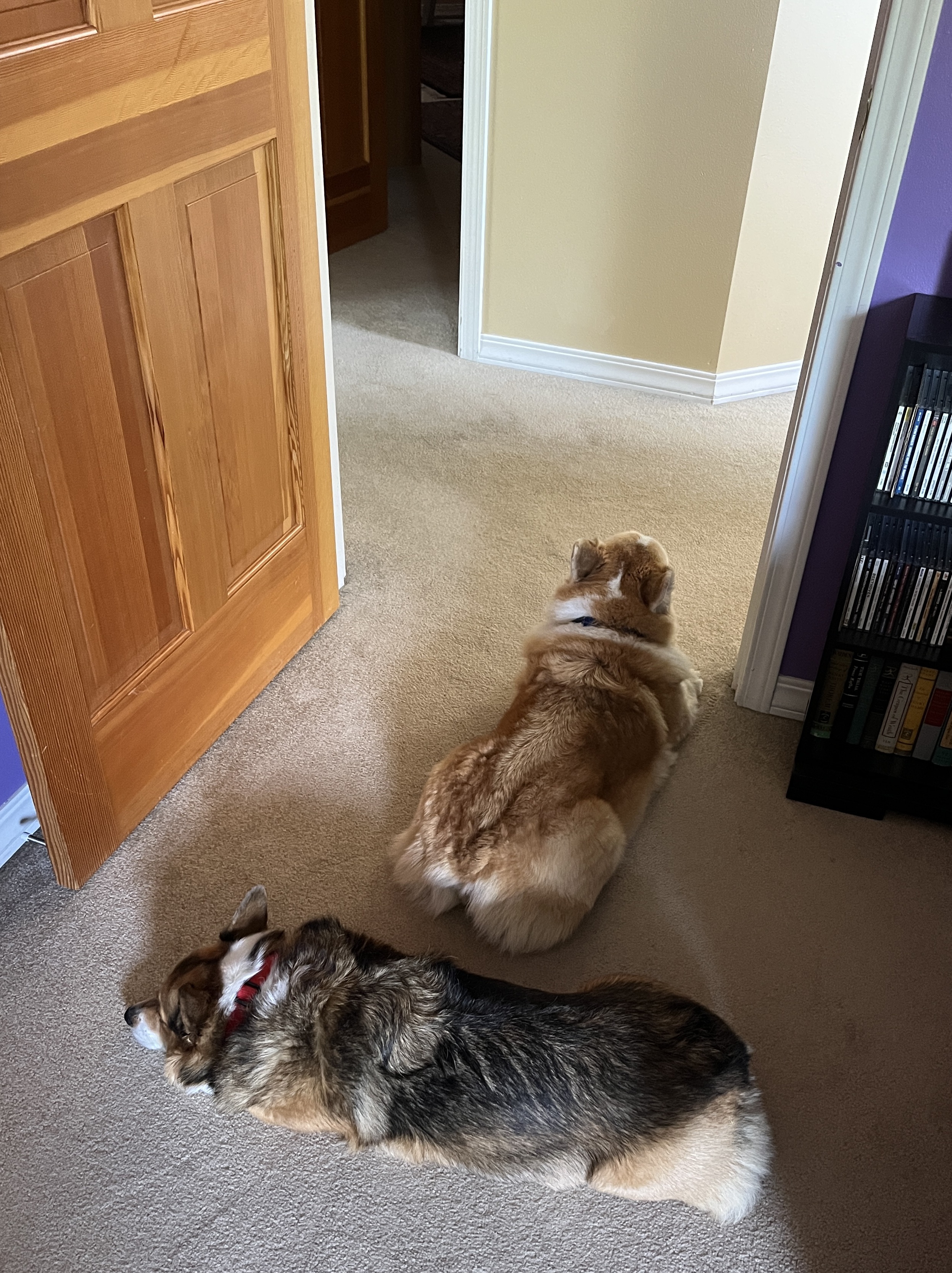
Lucky and Tango rest after a some major deconstruction in my archives.