What grasshoppers have to do with fame

Louisa May Alcott’s Little Women marches on. The story of Meg, Jo, Beth, and Amy has not been out of print since it was published in 1868 and no one can get enough of it, even though Laurie married the shallow sister, Amy, rather than the exciting and weird one, Jo. Laurie was not the first man to be hypnotized by a great pair of legs.

Alcott lived for another 20 years. Little Women’s instant success transformed her from a scrabbling, scribbling freelance writer who had to support her family and her parents into a writer who never had to worry about money again. She still had a publisher, though, and, like all publishers, they demanded a sequel: Little Men, which appeared in 1871. Little Men was my introduction to the March family. I found this treasure in the attic of my grandparents’ house, left behind by one of my aunts (five sisters with their own book club). Being a kid in 1871 was not like being a kid a century later, and yet the story immediately engulfed me.

[Heretical intrusion: Little Men aims lower than Little Women and it’s never going to gather a fan club, but it’s a better piece of writing overall. Nobody in Little Men spends a hundred pages swanning around Europe, falling in and out of love with idiots.]

In 1886, Alcott’s publisher prevailed on her to write a third book. She didn’t want to. She never set out to write a trilogy, and she was sick of these people, particularly Amy and Laurie. The result, Jo’s Boys, is what critics thoughtfully term “dreadful.” I read it in 2004 because I had given myself a reading theme of 19th-century American novels. I read all three books. I’m glad I didn’t start with Jo’s Boys because reading that one killed my theme. I rinsed my brain with someone’s memoir of their sex life.

“It is a strong temptation to the weary historian,” Alcott writes in Jo’s Boys, “to close the present tale with an earthquake which should engulf Plumfield and its environs so deeply in the bowels of the earth that no youthful Schliemann could ever find a vestige of it.”

After a brief rundown of how everyone turned out, Alcott concludes:

“And now, having endeavoured to suit everyone by many weddings, few deaths, and as much prosperity as the eternal fitness of things will permit, let the music stop, the lights die out, and the curtain fall for ever on the March family.”

Even in a doorstop like Jo’s Boys, Alcott’s talent is evident in three consecutive chapters, “Emil’s Thanksgiving,” “Dan’s Christmas,” and “Nat’s New Year,” in which she easily and convincingly handles a murder, German high society, and a shipwreck. What all those situations are doing in the same book is another issue.

A star is born, and she’s not happy about it

I’m writing about Jo’s Boys because of an early chapter, “Jo’s Last Scrape,” in which the author shows us what life was like for Jo Bhaer, the celebrity, in 1886—Jo of course being a stand-in for Louisa May Alcott. Her fans adored her. They sought her autograph, her advice, her money, her attention, her heart. “Strangers demanded to look at her, question, advise, warn, congratulate, and drive her out of her wits by well-meant but very wearisome attentions.”

Jo, trying to write, was beseiged in her own home, and it didn’t help that her kind-hearted but dimwitted family let these people in. She hid behind curtains, disguised herself as the maid, climbed out the window. Her own husband, Professor Bhaer, the most useless man in the literature of this country, brought home a troop of 75 young men from the YMCA in the middle of a rainstorm and they had to be entertained, too, because this was 1886 and good manners prevailed. (This being 1886, when the rain stopped, the young men gathered in front of the house and sang a song of farewell.)

If you’ve ever wondered why the McLean House, where Robert E. Lee surrendered to Ulysses S. Grant, is a reproduction, it’s because the souvenir-mad soldiers of both armies ripped the place apart after the surrender was signed.

I don’t ever expect to find super fans collecting sticks or grasshoppers from my yard or asking for an old scrap of my underwear they can weave into a quilt or a rug or reporters spinning fabrications from whatever bit of my life they spy through a half-open door. (All of which happened to Alcott.) I don’t have to disguise myself as the maid we don’t have or jump out a window and land on something in the garden that I’ll hear about later. But these pages from Jo’s Boys are a reminder that a good writer can make a good story from almost anything, and make me laugh 140 years later.
Thank God It’s Monday 11

“There isn’t enough televised chess,” David Letterman said back in the 1990s the night he had a young Garry Kasparov on his show. Everybody laughed, but this is the NBA now. Times have changed.

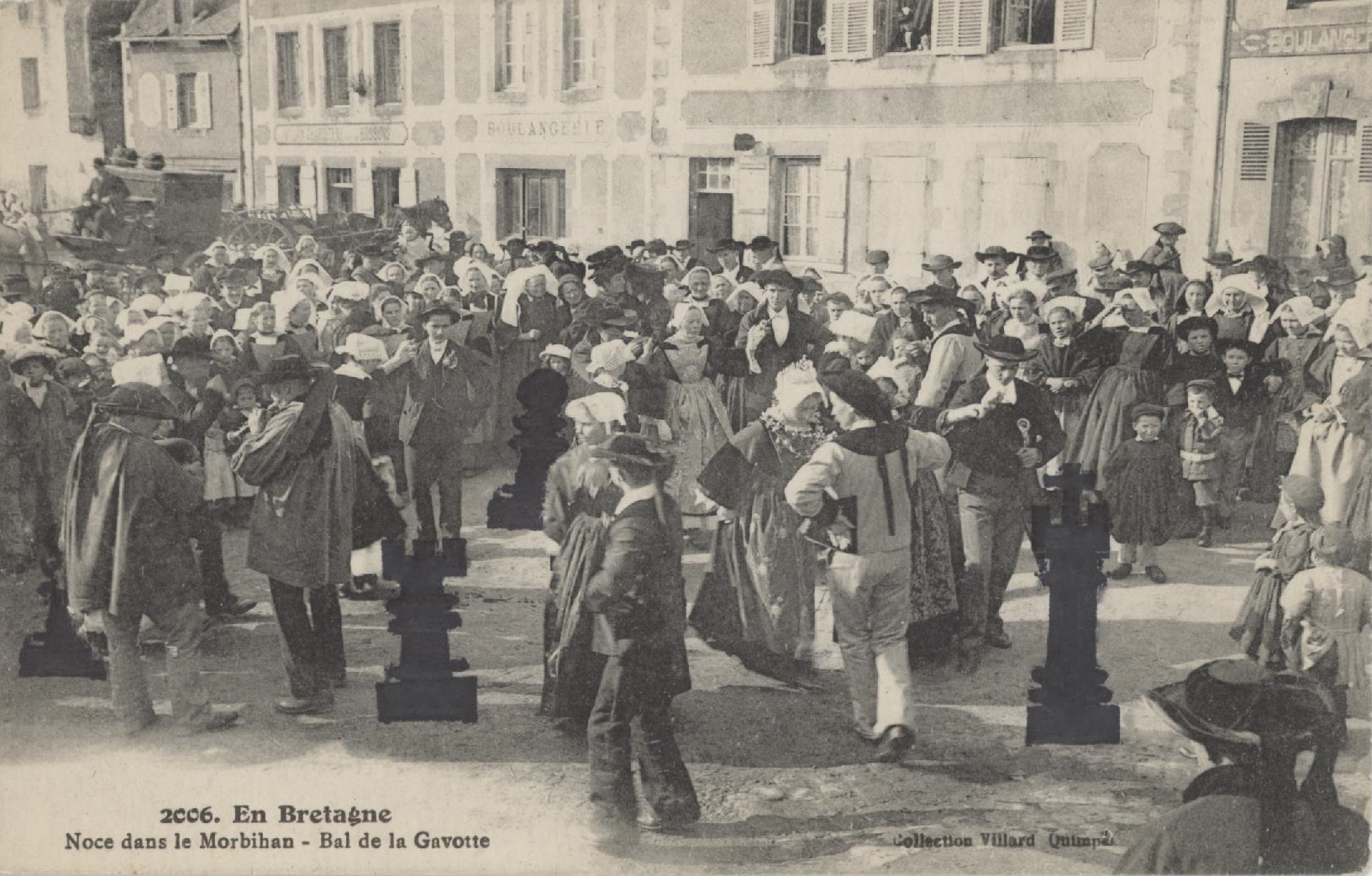
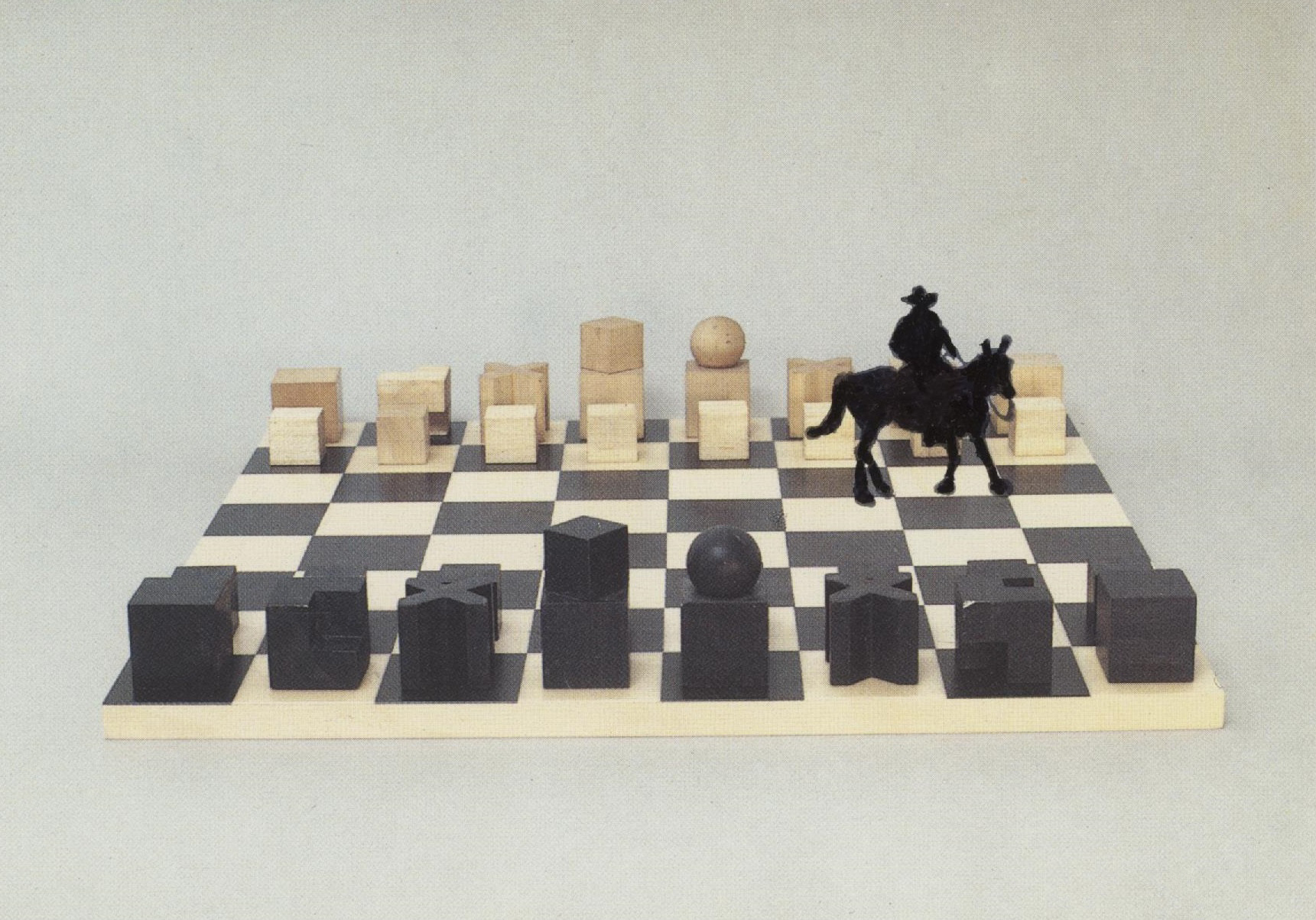
You might think it’s difficult to integrate rubber-stamped chess pieces with the images on old postcards. Think again. It’s easy.

This card is from the early 1900s and shows hundreds of costumed Normans doing the Safety Dance at a wedding in Morbihan. This is a crazy way to dress for a wedding, but it works well with the antiquated design of the chessmen. Everyone is looking in every direction so naturally some of these folks appear to be looking at the pawn, rook, and king.

If Carly Simon’s “You’re So Vain” has popped unbidden into your head, it’s because she rhymed “apricot” with “gavotte.” Yes, I think that’s crazy, too.

Bauhaus (the German art movement, not the British band) influenced the chess set depicted on this modern postcard. I dressed it up with my friend the cowpoke.

Bauhaus the band has a 28,800-word Wikipedia entry with 282 footnotes, which I believe exceeds the entries for the Seven Years War, the Great Wall of China, and David Letterman.

Stop chasing that muse. She’s too fast for you.

Like everyone who drives a car fueled by gasoline, I just topped off my tank and paid more per gallon than I have ever paid in my life.

Will the price I just paid look like a bargain by the end of the summer?

By the end of the summer, will the government force us to pay for gas using crypto?

I miss life when crypto was a dog.

We could all use some inspiration right now. To help myself and other writers, I’ve gone looking for words of encouragement from people who aren’t writers. Borrow from the best!

First up is the mistress of mail art, Melissa Hughes, who works with rubber stamps:

People often tell me they are waiting for inspiration or worse waiting for a “good idea,” as opposed to just an idea that maybe could be made good if it was allowed to be born, but we try to edit in the thinking stage and all that does is shut one down. I used to wait for inspiration, but that is kind of like waiting until it rains to get water to drink.

Don Carr, who died in 1993 and left us with his dreams, was a master of rubber stamps and colored pencils. Don was not afraid of showing up at his desk, grabbing his tools, and going for it. Go in the wrong direction? So what? “The mistake is sometimes more interesting than the intended impression,” he once said.

Babe Ruth would’ve known what Don meant. The Babe believed that every swing and a miss brought him closer to his next homerun.

The fear of error

This brings us to the late Chuck Yungkurth, an engineer by trade and a lover of trains, who wrote an essay with that title for Model Railroader in January 1978. Yungkurth had noticed something he couldn’t understand at his model train club: Armchair modelers. These men claimed they were enjoying the hobby in their own way:

I am skeptical. The stacks of kits and equipment are bound to be depressing. The number of times these would-be modelers turn up disposing everything at the annual auctions in our club leads me to believe that is the ultimate end for these people. The solution is to plan and theorize to a point—and then start construction.

But what if you screw up? Guess what, you will screw up. Babe Ruth knew that strikes are just part of the game. “Model railroading is a hands-on, learn-by-doing business,” Yungkurth wrote. “All really fine modelers can tell horror stories of early blunders…yet all consider these part of the learning process.”

I have to include one writer in this post, so I’m cuing up Garrison Keillor. According to our man Yungkurth, “there are almost no errors or mistakes that cannot be rectified, nor are there any real penalties for failure.” Keillor agrees: “Be bold, thrust forward, and have the courage to fail. After all, it’s only writing. Nobody is going to die for our mistakes or even lose their teeth.”

“Do something—do anything—and don’t be afraid of making mistakes,” Yungkurth wrote. Stop waiting for inspiration, my friend Melissa says. Mistakes might be interesting, and they’ll certainly teach you something, Don Carr knew.

The only secret: Show up at your desk.

  • Fifteen minutes a day.
  • Two hours a day, two days a week.
  • Early every morning or late every night.
  • “Daily writing and one day off”: One of my teachers, Merridawn Duckler.

There’s a schedule that will work for you. You’ll know it when you find it.

Chuck Yungkurth: “Better small than not at all.” This is Tango’s interpretation of me revising my novel. I type; she chews.