How well I remember the year 2000, and all the fun I had flying!
I could spend the day harassing travelers, engaging in public foreplay, riding the baggage carousel, and violating the airport’s operational security!
Not like flying today, which is dull, slow, and does not count as foreplay:
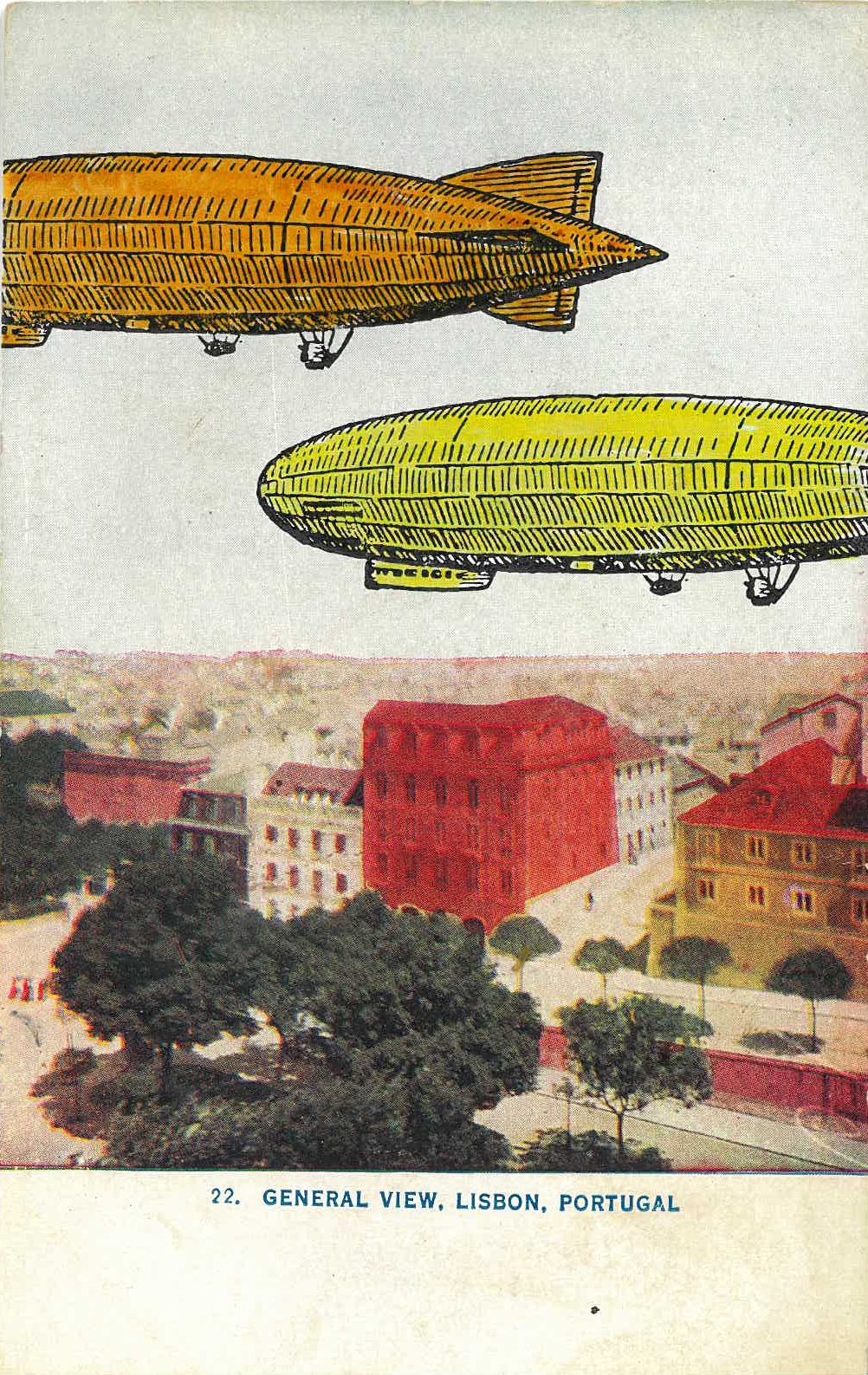
This card was stamped by the gnarly yet visionary mail artist Rudi Rubberoid. Rudi loved rigid airships: “If I had my way, I’d put blimps on just about everything!”
A century ago, Germany was the leading printer of postcards, but the inconsistent use of color, and the heavy hand of whoever painted that building in the middle, tells me that this card didn’t come from Germany. German colors (all of these old cards were black-and-white photos that were tinted before they went to press) were sharp and correct.
I have several blimp stamps I inherited from Rudi, but not this one. This card was published after 1907 but before the start of the war in 1914. Someone started a message on the back, in English, but never finished. Perhaps it was too beautiful a day.
Fun facts: The U2 video was filmed at the Charles de Gaulle Airport in Paris. Fake Bono was played by a 23-year-old actor named Emmanuel “Mac” Macron, who traded acting for politics and became president of France in 2017.
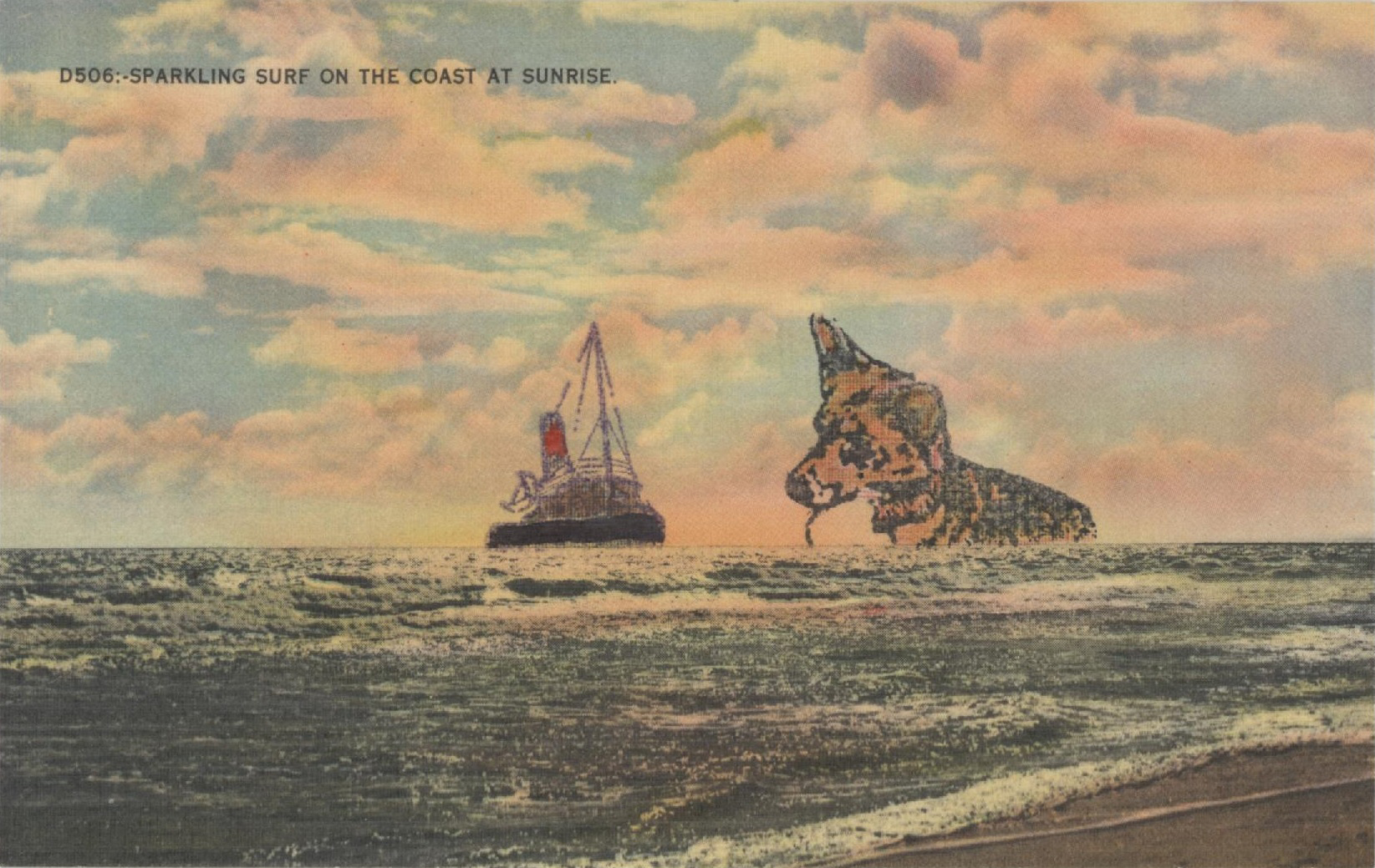
This is the first postcard I ever enhanced. I added the ship and the corgi. The ship’s wake turned out well, and I somehow managed to line it up so that the hull seems to reflect off the water. The card is from the 1930s. I attacked it in the 1990s.
As I prepare for yet another awesome vacation, I am reminded of all the bad writing advice that exists in the world, some of it provided by me. This stands out: “Bring your book on vacation with you.” This tidbit comes from Unstuck: A Supportive and Practical Guide to Working Through Writer’s Block by Jane Anne Straw (2003).
After extensive testing, some of it chronicled in this space, I can attest that this advice is nuts. You are far better off bringing your flip-flops.
However, if you’ve established a daily or almost daily writing practice, there’s no reason to abandon this on your vacation. You can always sneak away for 15 or 30 minutes with your laptop or tablet or pad of paper or Olivetti portable typewriter. I like the final page of the benefits statements I receive from my health insurer, the page that’s printed with THIS PAGE LEFT INTENTIONALLY BLANK.
Describe your day or the inside of your head. Try out openings or a big head-butting scene. It’s all practice and if you never keep any of it, you will eventually write something based on your beach-blanket or poolside scribbles. Good luck. Aloha.
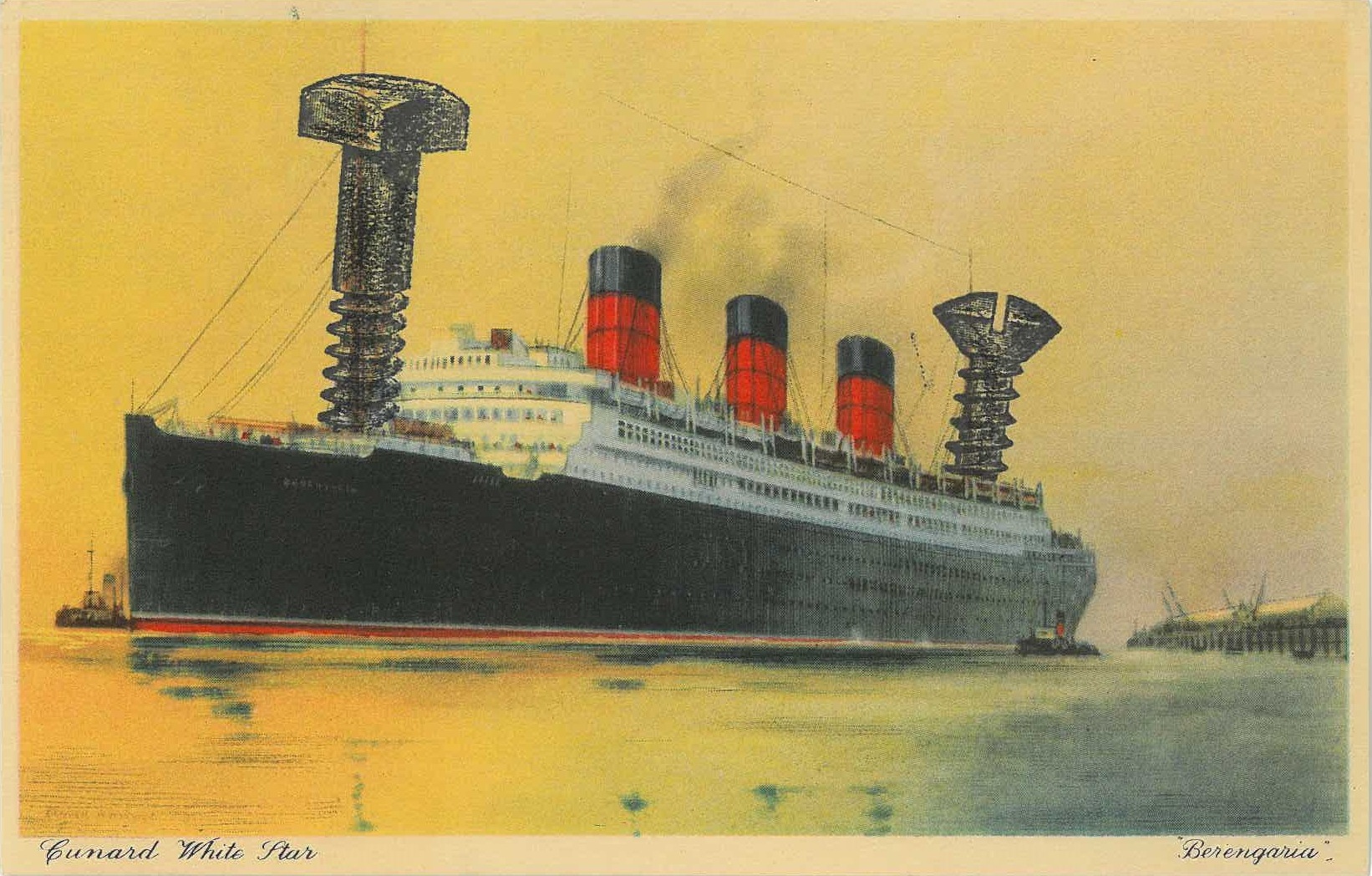
She was launched in 1912 as the German liner Imperator. She had some teething troubles, and was nicknamed the Limperator. After spending World War I heroically tied to a pier, she was seized by the victorious Allies. The U.S. used the ship to transport troops home from Europe. In 1919, she was handed over to the British government, who handed her off to the Cunard Line. Her first Cunard Line captain was Arthur Rostron, who captained the Carpathia when that ship rescued 700 survivors from the Titanic.
The Titanic, of course, was the definition of teething troubles.
Cunard merged with White Star in 1934, and the merged company retired the Berengaria in 1938, so there’s the date range for this postcard. Berengaria ran aground several times, and if you had her wiring in your house you’d keep a fire extinguisher in every room, but she also came to the aid of a foundering liner in the middle of the Atlantic.
I inherited the rubber stamps from my friend Jack, and he received them as unmounted rubber images, so I can’t tell you the manufacturer. Probably a company that went out of business in the 1990s.
Girl smashes chess barrier
In honor of today’s female theme, I am happy to announce that Bodhana Sivanandan, an 11-year-old from England, just became the world’s youngest Woman Grandmaster in history. She played first board for the English team at the Women’s Olympiad in Samarkand. In her 10 games she was defeated once, by the 33-year-old WGM Deysi Cori of Peru.
As a chess player, I am far above average. But if I were to play 100 games against Ms. Sivanandan, I might manage a draw or two. I might win a game if she got bored or wanted to watch Stranger Things or The Baby-Sitters Club.
Weird girls unite
Chess-playing girls are not weird. But there is today a literary trend called “weird girl lit.” “Weird girl lit” is a reader’s label, says agent Danielle Bukowski. “No deals in Publishers Marketplace have ever been announced with the phrase ‘weird girl lit.’ ”
Instead, publishers announce weird-girl books “for fans of” Ottessa Moshfegh, Mona Awad, Melissa Broder, and Jen Beagin, even though these authors did not choose this label. Just guessing here, but I’ll bet Ottessa, Mona, Melissa, and Jen call them “books.”
Bukowski: “Everyone generally understands a weird girl book to be about a young woman who can’t cope with modern life and makes a weird choice to try to evade conventional expectations.”
This sub-sub-subgenre has gained so much steam that it’s also gained a backlash. Bukowski recommends Jesca Dawn’s TikTok series “Weird Girl Lit that doesn’t center white women.”
When I told Deborah about this, she said it sounded like a High Times headline: WEIRD GIRL, LIT.
Gone girl
Berengaria (1165–1230) was a medieval English queen. She might have played chess, though if she had there wouldn’t have been a queen on the board. She might have written weird-girl lit. Who else in that era could read and write except monks and royals? She might even have taken an ocean voyage, as her husband, Richard, took her with him on the Third Crusade. He must have thought she was weird because he dropped her off in France.
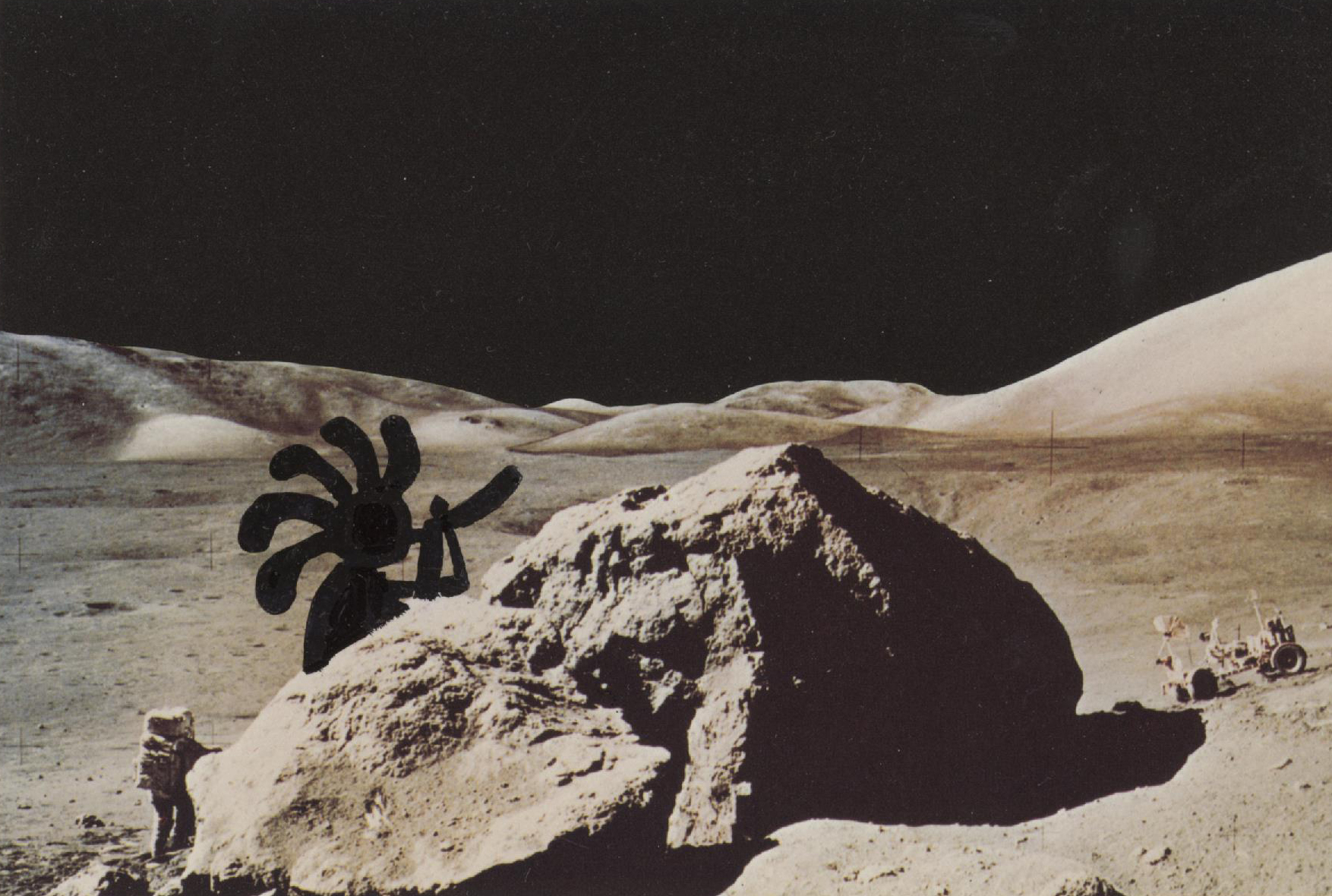
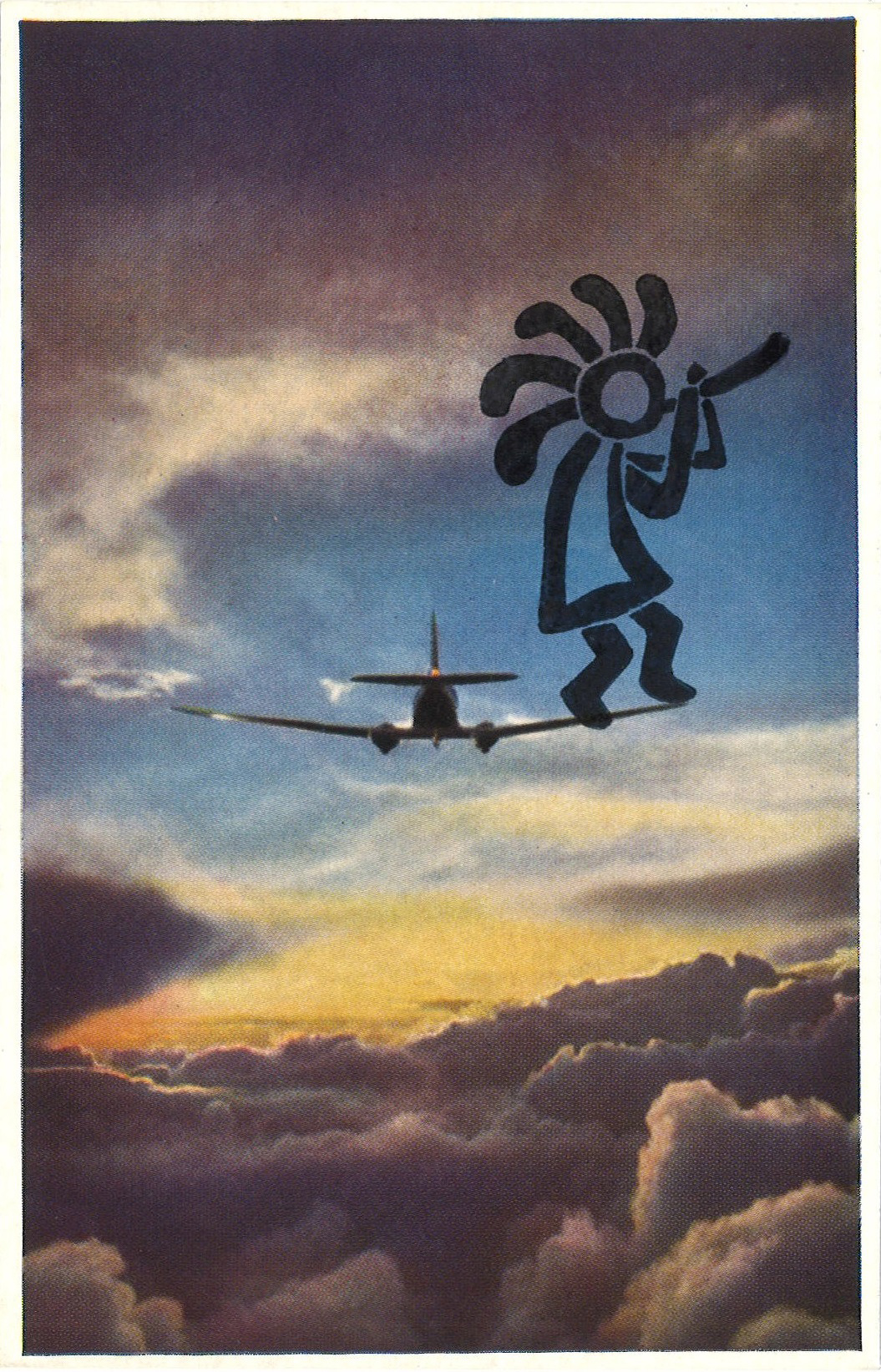
I know this is appropriation. Kokopeli belongs to someone else’s culture, not mine. I can’t resist him. He’s always messin’ ’round with his tricks. Unlike Secret Agent Man, who, according to the song, “Odds are he won’t live to see tomorrow,” Kokopeli will always be with us. He can’t wait to see what will happen next. If necessary, he’ll make something happen.
Kokopeli is all about aeronautics. It was no trouble for him to meet the Apollo astronauts on the Moon. I filled in his outline with a black marker to match the stark light and shadow contrasts.
Note the Lunar Rover in this 1969 postcard. Most shots of this vehicle were taken not at this distance but from close range.
After an adventure in space, a little wing-walking is easy. And if you think this is far-fetched, watch the documentary Man on Wire, about Philippe Petit’s tightrope walk between the Twin Towers in 1974.
This postcard, which is also from the late 1950s, was one of the last cards to be hand-painted from a black-and-white photo.
Tomorrow is September 1. Our tightrope challenge begins!
It’s still summer, so here are two vacation shots.
Falling woman goes anywhere. Literally. To match the birds in flight, I used a black market to color her in. I love these silhouette cards, which are always from the beginning or the end of the day.
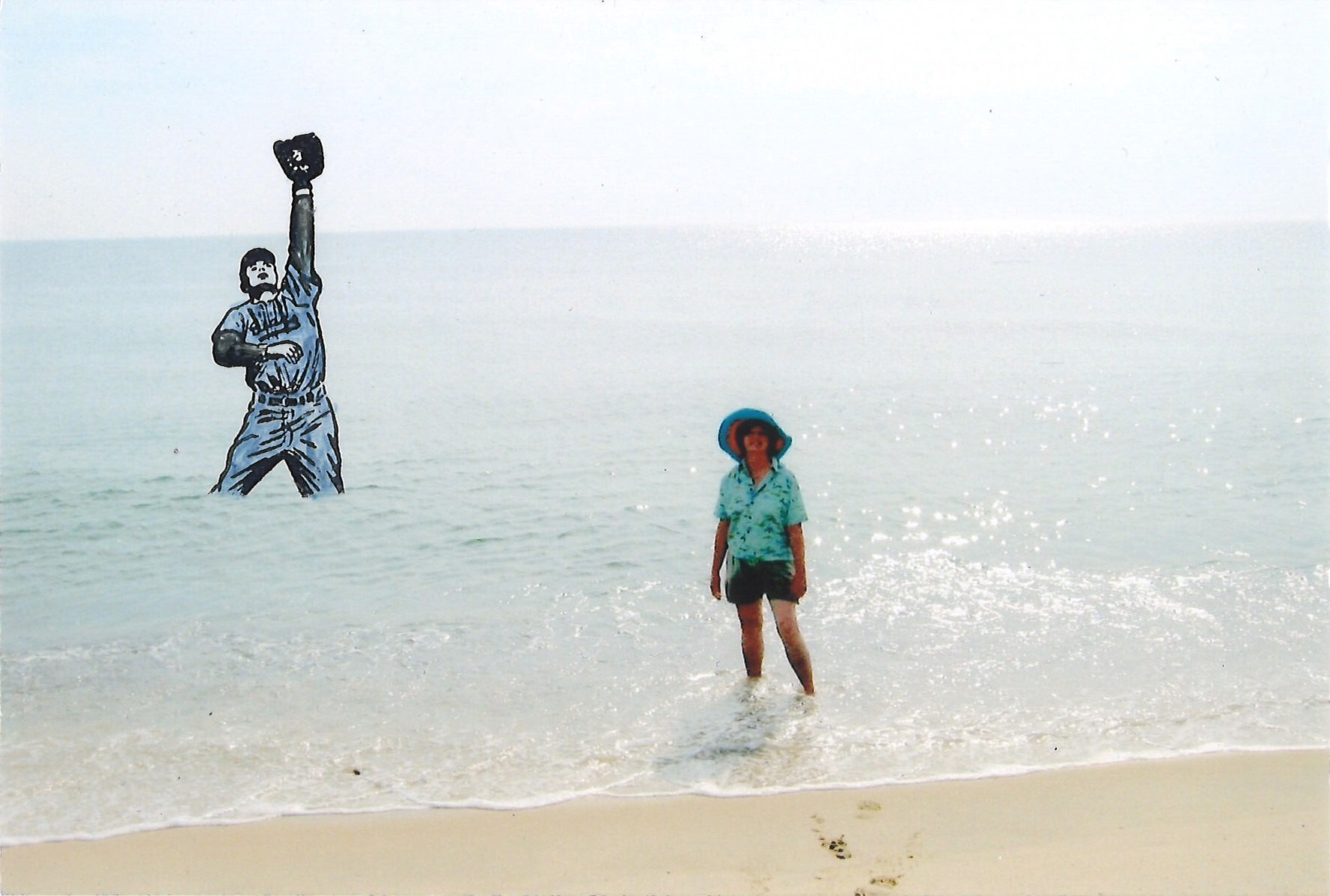
A typical wife at the beach. She’s about to turn to take the relay from the outfield. Stamping on photographs is tricky. I got lucky with this one.
I’ve been asked what stamp pads I recommend. For black, Versafine or Ranger. Versafine, made by Tsukineko, bills itself as “the longest lasting pigment inkpad available.” Ranger, from Ranger Industries, calls its pads “archival.” I’ve had excellent results with both. Versafine and Ranger pads are thick enough to stand above their plastic frame. That means you can ink up a rubber stamp image that’s larger than the pad itself.
Do NOT spend your money on stamp pads that are advertised for school or office. They don’t last. Even the U. S. Postal Service, which is not exactly a champion of technology, uses self-inking stamps.
At a recent estate sale I ran across a picnic table of art supplies. I picked up stamp pads I’ve never seen before: A deep-sea blue from Inkadinkado, a teal from MementoLuxe (also made by Tsukineko), and three weird colors, including “pesto” and “pool,” from Sea Brights and Adirondack (both made by Ranger).
I also bought a letter set, but as usual I was disappointed. Searching through a letter set one letter at a time to find the one you want is like hunting and pecking on a typewriter. At least on a typewriter you get the little bell at the end of the line and when you’re done you don’t have to put the letters away.
I’m in love with this thing, which was made in the 1950s and is surprisingly quiet. I haven’t convinced anyone to buy it for me…yet.
Some postcards are as common as crows. The Tacoma Totem Pole was erected in downtown Tacoma in 1903. This postcard, published in the 1920s, shows up again and again at postcard shows, usually in the bargain box. This has given me multiple opportunities to deface it. Here are two:
was stuck there in the first place because Seattle had already stolen a pole from a tribe in Alaska, set it up in Pioneer Square, and bragged about it.
Tacoma wanted something to brag about, too. At least they didn’t steal it.
I’m laying down the law. Don’t buy white ink pads.
This postcard was published in Germany before World War I. There are probably beach towns up and down the West Coast of the United States that claim the same scene but with their name on it.
Here’s another example:
This card was published in the 1920s in the USA. The style has changed; it’s more painterly than photographic. Also, the printing is not as crisp.
Unfortunately, a white stamp pad will pick up every other color you use, unless you steam-clean each stamp before you use it. Trying to safeguard the precious bodily fluids of a white stamp pad gets really boring really fast. I tried it twice and gave up. A white stamp pad is about as useful as a white No. 2 pencil. (I’ve tried that, too.) Now I’m back in black.
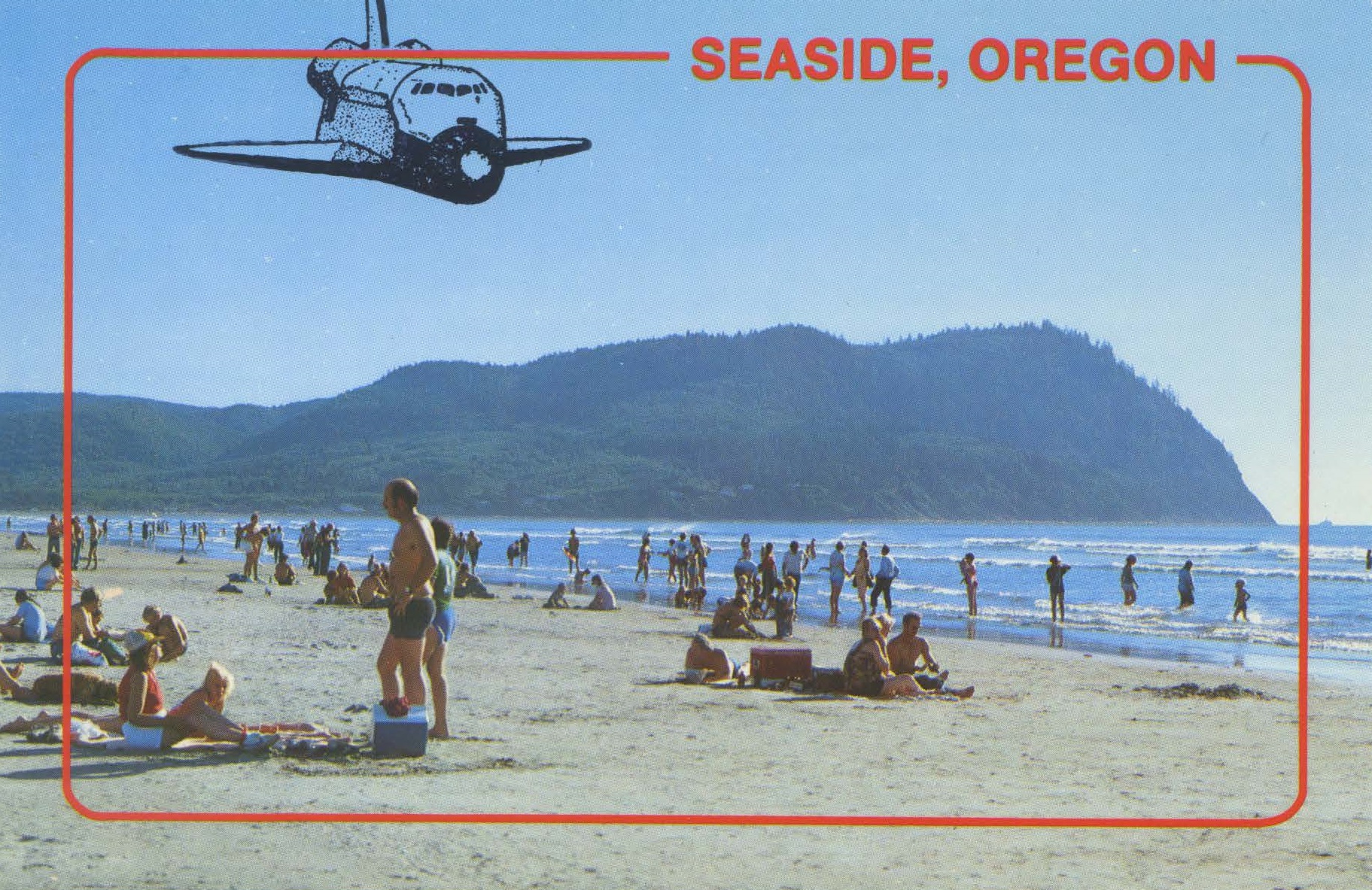
Stamping on modern cards with a plastic surface (referred to by deltiologists as “chromes”) is chancy. You might achieve a smart finish and you might achieve a smear. I did well with this one:
How did I stamp the space shuttle behind the red line? Analog fussing at its finest: First I used tracing paper and a pencil to get something the same width. I cut it out and placed it over the line. Sticking it down was simple: I used a Post-it at each end. I inked the stamp and hoped for the best. It worked!
I probably stamped this 20 years ago. The image eventually dried enough for me to scan it, but even today, if I touched it, the natural oil on my skin might ruin it.
This may be one of the few beach postcards ever published to feature a Dad in a bathing suit.
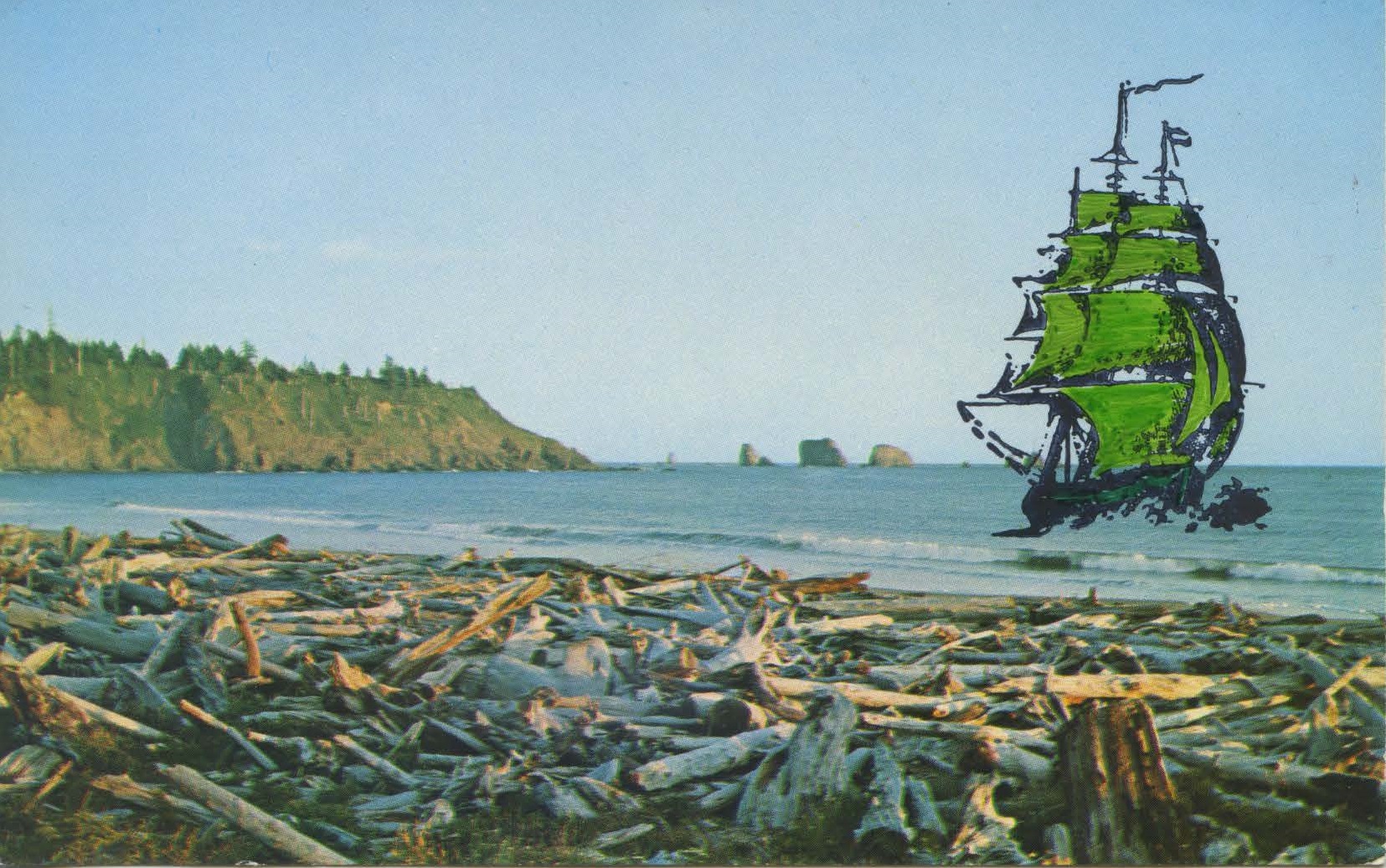
Here’s an example of how not to do things:
This is another Oregon beach. Note the light on the driftwood. The sun is setting. The card’s surface took the ink well. But I should’ve left the sails alone or painted them a pale blue or gray to blend with the sea and sky. And I definitely should’ve masked the bow’s shadow. The stern’s shadow is correct for this coast and this time of day, but not the bow’s. Using this image taught me to follow the light. We should all follow the light.
Some postcards are bizarre. There is no point in altering them. They are perfect:
This card preceded the Mary Poppins movie by approximately 60 years. I call him Marty Poppins. I considered stamping springs under his shoes or adding fireworks, but why? The publisher said it all.
At the time this card was mailed, it was illegal to write anything on the blank side except for the name and address of the recipient. People did it anyway, so the law was changed. Jack, the man who mailed Marty, was a law-abiding citizen.
Other cards cry out for alterations…except for this next one, because whoever mailed it, all those decades ago, added a message that will live forever:
I bought each card because I loved them as they are, not because I thought I could improve them. I can’t improve them.
“There isn’t enough televised chess,” David Letterman said back in the 1990s the night he had a young Garry Kasparov on his show. Everybody laughed, but this is the NBA now. Times have changed.
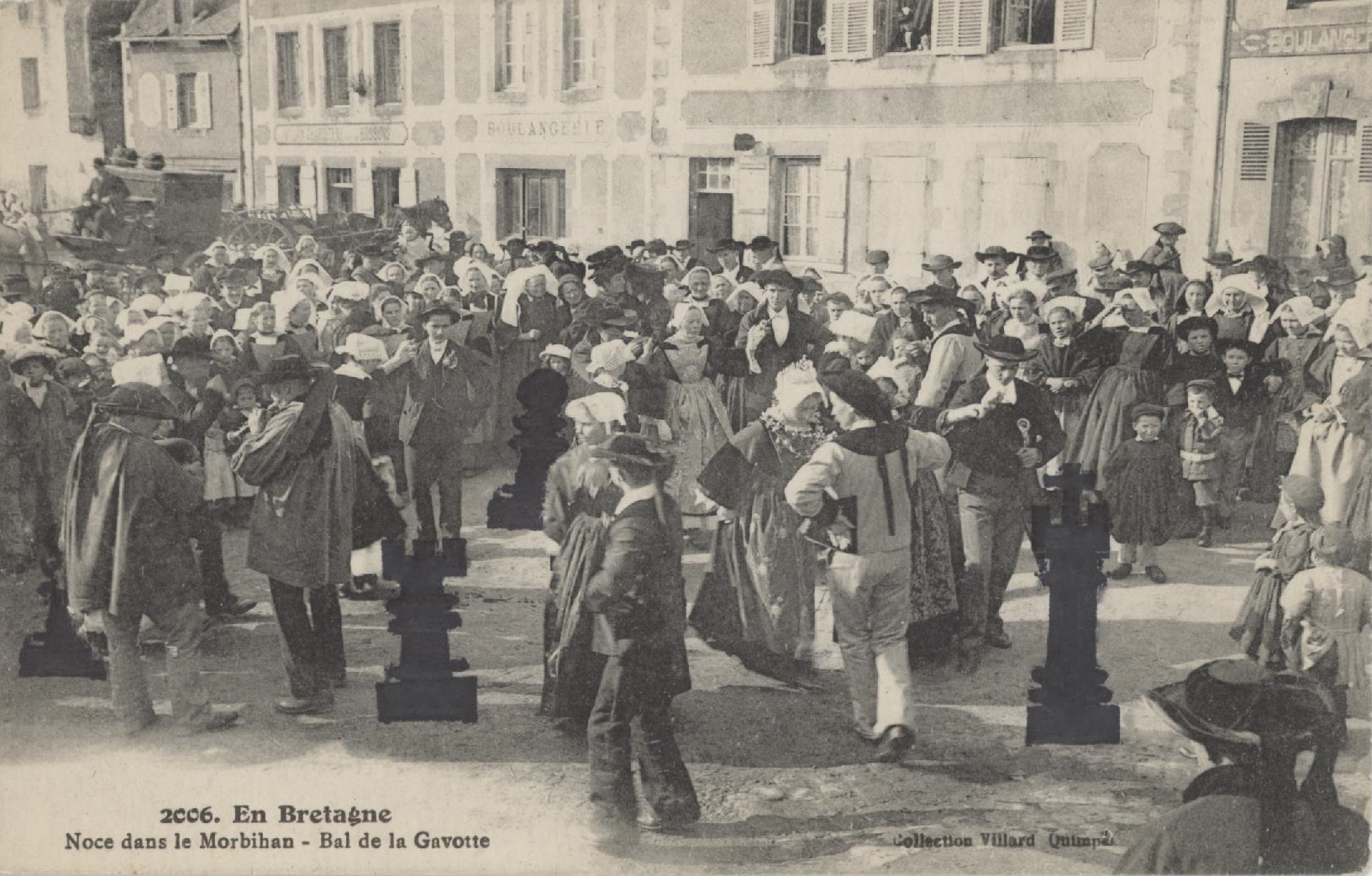
You might think it’s difficult to integrate rubber-stamped chess pieces with the images on old postcards. Think again. It’s easy.
This card is from the early 1900s and shows hundreds of costumed Normans doing the Safety Dance at a wedding in Morbihan. This is a crazy way to dress for a wedding, but it works well with the antiquated design of the chessmen. Everyone is looking in every direction so naturally some of these folks appear to be looking at the pawn, rook, and king.
If Carly Simon’s “You’re So Vain” has popped unbidden into your head, it’s because she rhymed “apricot” with “gavotte.” Yes, I think that’s crazy, too.
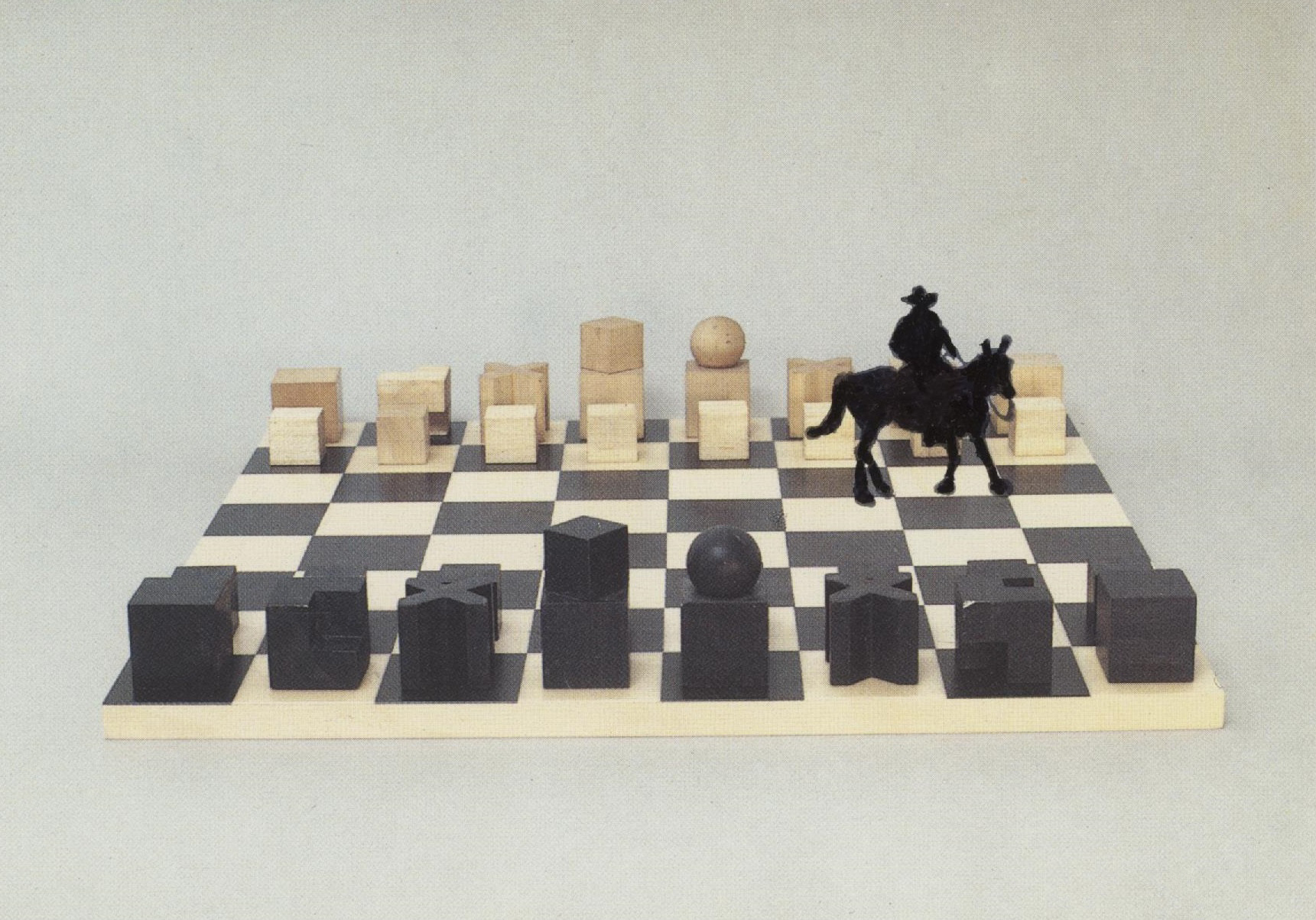
Bauhaus (the German art movement, not the British band) influenced the chess set depicted on this modern postcard. I dressed it up with my friend the cowpoke.
Bauhaus the band has a 28,800-word Wikipedia entry with 282 footnotes, which I believe exceeds the entries for the Seven Years War, the Great Wall of China, and David Letterman.