The writer I wish I were

I became aware of myself as a writer at the age of 11, in Mr. Gray’s sixth-grade English class. Every Friday was Composition Day. It was our challenge to write something there at our desks, on our ruled paper, and read it before the class. Some Fridays, we had an assignment, or what today would be called a prompt. On other Fridays, we were free to write whatever we wanted.

On those Fridays in that long-ago year I discovered three things: I could write under pressure to meet a deadline. I had zero stage fright. And my fellow sixth-graders enjoyed hearing what I had written and often broke into applause.

What did I write back then? I wish I had kept those smudged pages. I can still visualize what they looked like, just as I can see certain positions I found myself in on the chess board no matter how much time passes. I wrote whatever the day’s assignment required, and when I had no one to answer to but myself I wrote about my family. They were always good for a laugh, especially if I added Martians, robots, and outfielders.

In those days, the writers I wanted to be were the writers I read: Ray Bradbury, Andre Norton, C.S. Forester, and whoever wrote the boys’ baseball books starring such stalwart sluggers as Ace Atkins. If I had started writing at the age of 6, they might have been Crockett Johnson (Harold and the Purple Crayon) and Robert McCloskey (Make Way for Ducklings). As I grew up and the conviction I wanted to write grew stronger, I imagined myself writing like Thomas Wolfe, Charles Dickens, and W. Somerset Maugham. And then Margie Percy, John Updike, Franz Kafka, and Ursula K. Le Guin.

When Michael Cunningham sits down to write his next novel, he has a vision of what the novel will be: “vast and revelatory and awe-inspiring. It’s a cathedral made of fire.” But:

Even if the book in question turns our fairly well, it’s never the book you’d hoped to write. It’s smaller than the book you’d hoped to write. It’s an aggregation of sentences. It doesn’t remotely resemble a cathedral made of fire. It feels, in short, like an insufficient translation of a mythical work.

Cunningham calls this “one of the heartbreaks of writing fiction.” Another is the knowledge that you’ll never be Ursula K. Le Guin or even Crockett Johnson. Though I believe I would’ve done a creditable job with baby ducks trying to cross a damn road.

Cunningham, in Unsayable: A Life in Writing, which is an autobiography with writing advice or a writing manual with some memoir, knows exactly what I’m trying to say:

Writing is difficult enough without adding the imperative to evolve into the writer you wish you were.

To all of you out there who are writing here in my end-of-the-year writing challenge (I should’ve thought of a better name for this), keep writing. Be kind to yourselves. And read Unsayable, which was just published. The author provides the encouragement we all need…plus drag queens and ghost stories. I would like to have seen Thomas Wolfe try that.

Thank you, Franklin A. Gray, English teacher extraordinaire. When I read his obituary, I discovered that he had also been a radio announcer under the name “The Shadow.” Rest in power.

Thank God It’s Monday 20

Tonight: A brief word about pencils.

But first, our dog Tango, a noted corgi. Early this evening, on the deserted (I thought) campus of Western Washington University, she surprised a six-point whitetail deer and chased it for a quarter of a mile. Spoiler alert: The deer escaped.

Tango’s behavior taught me never to let her off the leash on campus again. But it also, in a weird way, reminded me of my Dad and how we both loved office supplies. When I was in high school and we found out that a local “stationery store” was having a going-out-of-business sale, we RAN to the car. We chased bargains, not ruminants.

Most office-supply stores today belong to a chain and everyone sells the same thing, but with different packaging and different celebrity endorsers. The last time a stationery store in my area expired, it was 20 years ago, we lived in Portland, Oregon, and the treasure I came home with was the colorful stickers we stuck on floppy disks in the 1980s.

Before Dad went to that great office-supply ammunition dump in the sky, he gave me all of the unopened boxes of pencils he had accumulated since he came home from World War II. I ended up donating many to an elementary school; a teacher there told me that his third- and fourth-graders chewed right through them. I sold other pencils on eBay. I still have enough to last me my lifetime.

There’s something about pencils, and their fragrance, that makes you happy. Like skipping stones. You can’t skip a stone and not be happy. You can’t open a box of pencils and not feel happy looking at all that unsharpened potential.

Two writers who have meant a lot to me, Thomas Wolfe and John Updike, wrote with pencils.

Wolfe, who was six and a half feet tall, used the top of a refrigerator as his desk. His preferred tool was a pencil almost as thick as a crayon. He scrawled 20 or 25 words on a page, then swept the page off the fridge and started on the next.

Updike, who liked to sit in a chair, wrote Couples and three of the four Rabbit books with a pencil.

Am I going to write the next draft of my novel with a pencil? How about hell no? I have about the same chance of finishing such a thing as I have of catching a deer.

I didn’t write this post with a pencil, either, but I did use a pencil (a Wolkins “Debut”) to write my to-do list today. And I’m now using a pencil (a red PMC Tailoring Pencil No. 249, proudly made in the U.S.A.) to cross out BLOG.

“Lying in bed would be an altogether perfect and supreme experience if only one had a colored pencil long enough to draw on the ceiling.” (G.K. Chesterton)

I believe in starts

I needed a bench to cut wood using my handsaw. I wanted something low enough that I could hold the material in place with my foot but not so low that the tip of my saw would strike the floor of the garage. I mocked up this invention with cardboard, then bought some scrap wood at The RE Store, our local, one-stop, scrap-wood emporium.

Then I was sidetracked by other things—that is, life.

One day I decided I needed a bench to cut wood using my handsaw. While thinking this over in our garage, I spotted a rectangle of plywood that was the exact size I wanted for this project. I had already measured the damn thing and bought the wood. Yes, the Enterprise was once again stuck in a time loop.

Before I could drink enough coffee to gear up for this project, my wife and I went to an estate sale where I discovered a wooden, slatted box from a wine distributor. It was sturdy and it was the approximate dimensions of the bench I had designed in my head. I turned it upside down and borrowed a bubble level that was on sale. The box didn’t wobble and the bottom was exactly level. I bought it. My project was done!

Back around Memorial Day, I decided to cut my novel up with a handsaw. In other words, I required a Big Think. When I picked the book up again last week, I had done my thinking, but I had forgotten which files I was using, and the file names I had concocted in May and June were somewhat opaque here in September. I can’t say if I was back in a time loop or if my brain required a defrag and disc clean-up, but this predicament forced me to engage with each file and understand them all over again. I’ll call that a win.

So my first week of the end-of-the-year writing challenge (I should’ve thought of a better name for this) turned out to be mostly some frantic reorganizing, but by the end of the week, I was writing. A slow start is still a start, and as Joey “The Lips” Fagan proclaimed in The Commitments, “I believe in starts.” He wasn’t talking about tomato plants, either.

Good luck to you as we lurch into Week 2!

Writing tip of the day

If one of your characters is working in a profession you know little about, listen to some podcasts. Podcasts are an insanely proliferating species. If two people are in the same career, you can be certain that one of them has begun a podcast about it and asked the other to make a guest appearance. This is the fastest way for you to gain this information.

Look over their episodes and search for titles such as “How to Be a Success in Your First 90 Days” or “Top 5 Mistakes to Avoid.”

Consumer warning: Most podcasters are not trained broadcasters. They speak too slowly, they say um, you know, and like like like. They’ll wander off the point and waste time. Also, shows about professions often degenerate into festivals of self-congratulation or tales of how we did things in the old days. That’s why God invented the Skip function. Use it!

Thank God It’s Monday 19

I know this is appropriation. Kokopeli belongs to someone else’s culture, not mine. I can’t resist him. He’s always messin’ ’round with his tricks. Unlike Secret Agent Man, who, according to the song, “Odds are he won’t live to see tomorrow,” Kokopeli will always be with us. He can’t wait to see what will happen next. If necessary, he’ll make something happen.
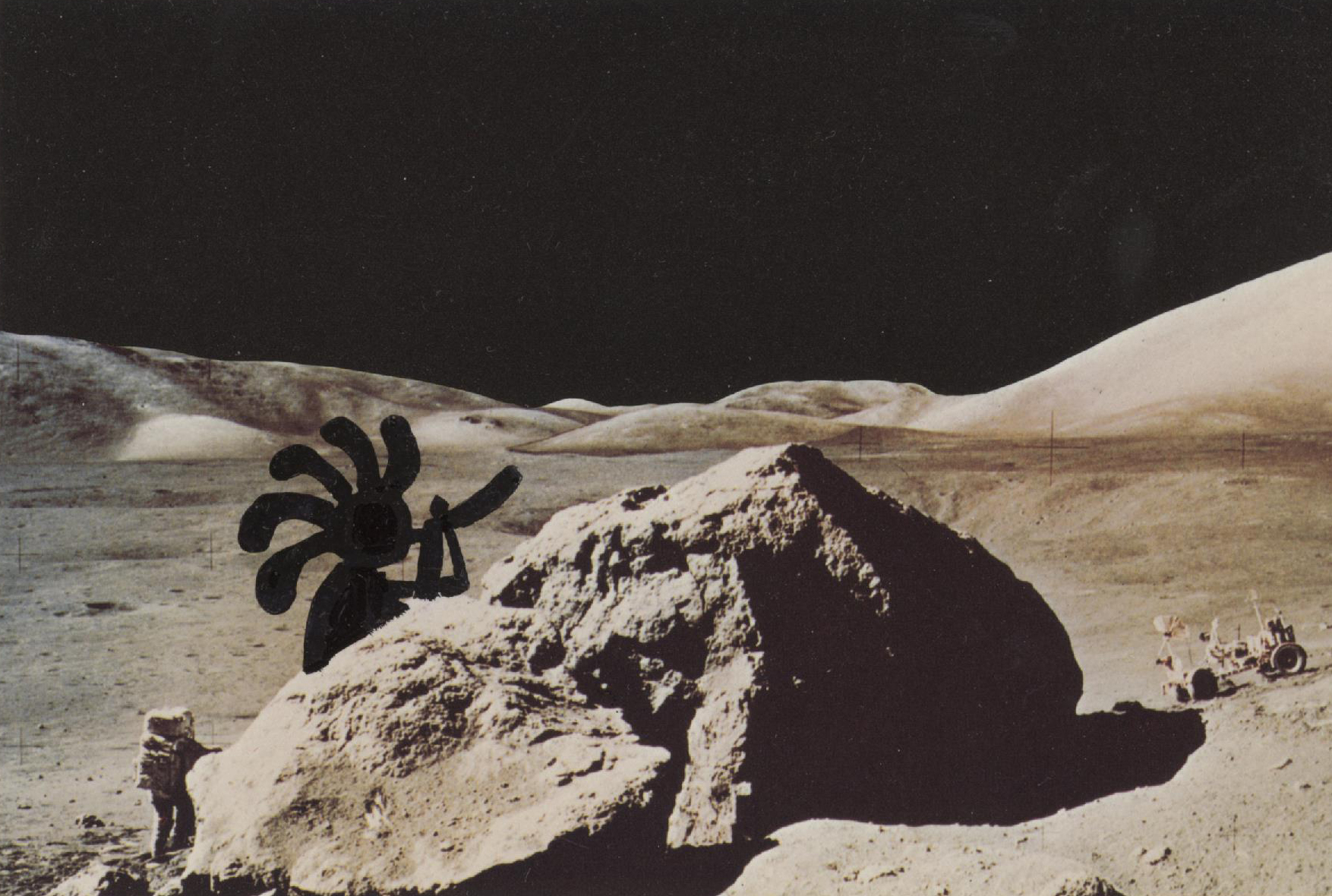
Kokopeli is all about aeronautics. It was no trouble for him to meet the Apollo astronauts on the Moon. I filled in his outline with a black marker to match the stark light and shadow contrasts.

Note the Lunar Rover in this 1969 postcard. Most shots of this vehicle were taken not at this distance but from close range.
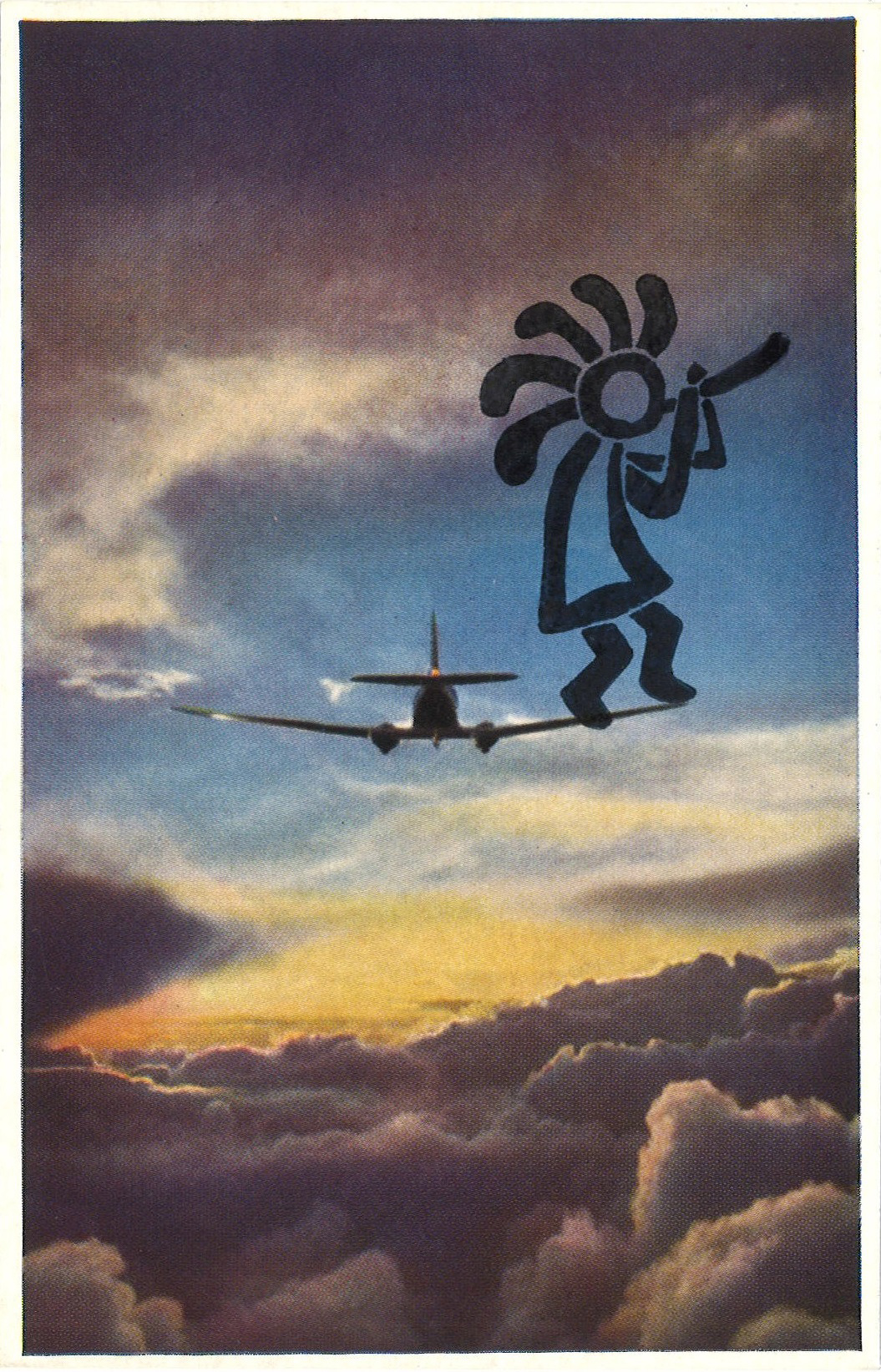
After an adventure in space, a little wing-walking is easy. And if you think this is far-fetched, watch the documentary Man on Wire, about Philippe Petit’s tightrope walk between the Twin Towers in 1974.

This postcard, which is also from the late 1950s, was one of the last cards to be hand-painted from a black-and-white photo.

Tomorrow is September 1. Our tightrope challenge begins!