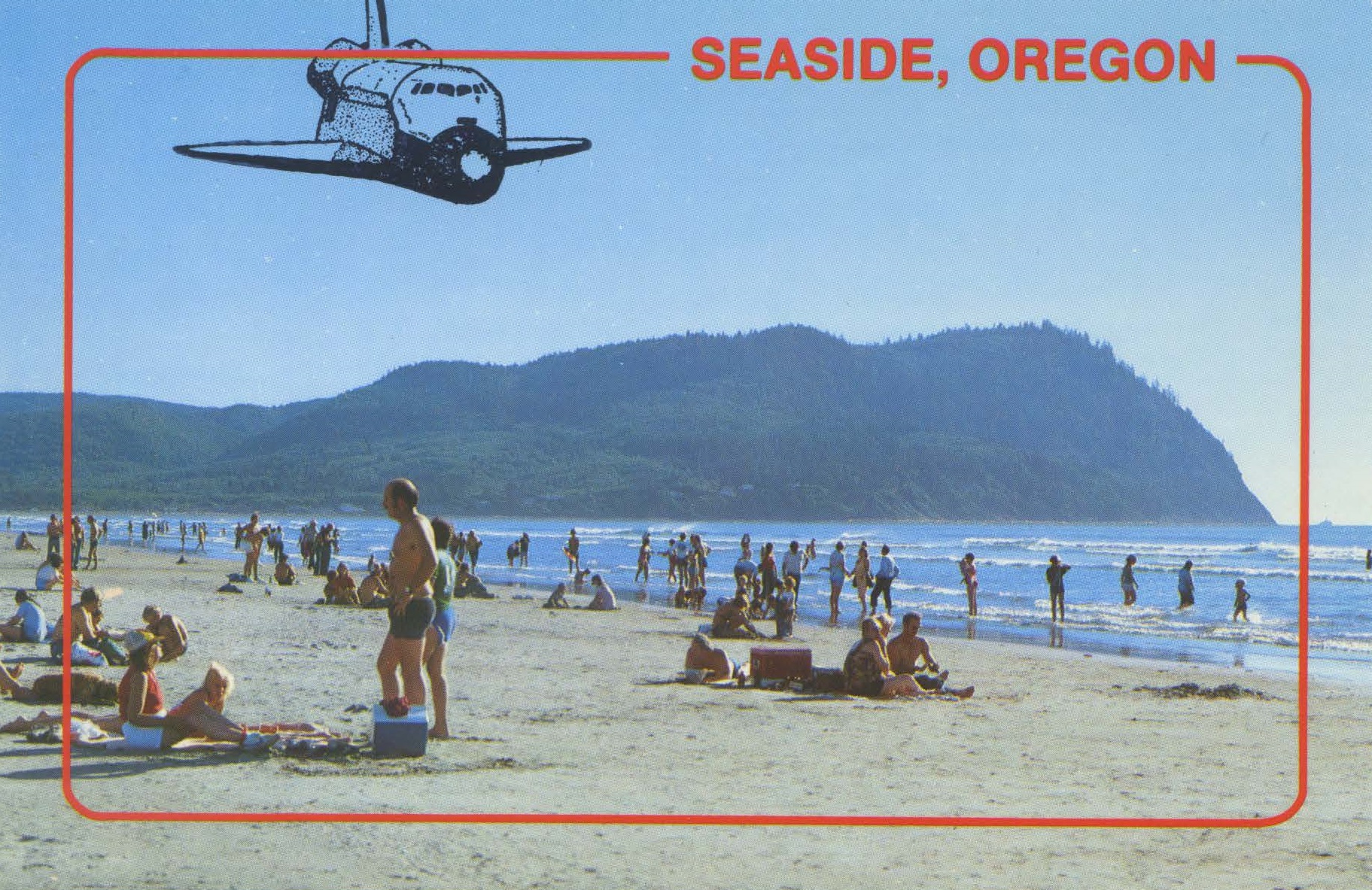
Stamping on modern cards with a plastic surface (referred to by deltiologists as “chromes”) is chancy. You might achieve a smart finish and you might achieve a smear. I did well with this one:
How did I stamp the space shuttle behind the red line? Analog fussing at its finest: First I used tracing paper and a pencil to get something the same width. I cut it out and placed it over the line. Sticking it down was simple: I used a Post-it at each end. I inked the stamp and hoped for the best. It worked!
I probably stamped this 20 years ago. The image eventually dried enough for me to scan it, but even today, if I touched it, the natural oil on my skin might ruin it.
This may be one of the few beach postcards ever published to feature a Dad in a bathing suit.
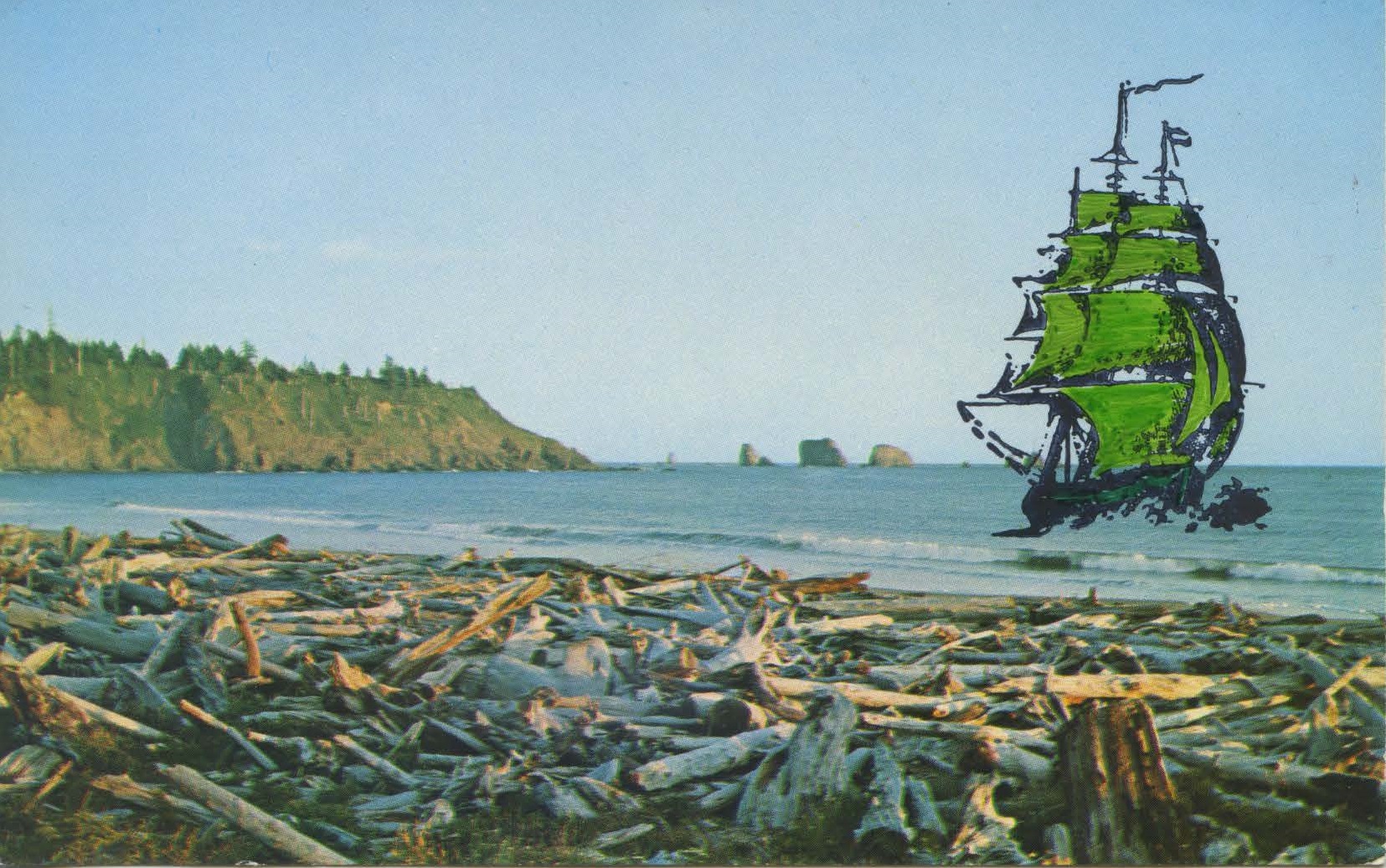
Here’s an example of how not to do things:
This is another Oregon beach. Note the light on the driftwood. The sun is setting. The card’s surface took the ink well. But I should’ve left the sails alone or painted them a pale blue or gray to blend with the sea and sky. And I definitely should’ve masked the bow’s shadow. The stern’s shadow is correct for this coast and this time of day, but not the bow’s. Using this image taught me to follow the light. We should all follow the light.
I go to a writing conference every 20 years. So when I go, I had better make the most of it. The Port Townsend Writers’ Conference at Fort Worden, Wash., was the most.
It’s going to take me awhile to digest this experience. All I’ll say this evening is that my week at the conference was inspiring and surprising. I wrote something I never thought I’d write and made connections with people I never thought I’d meet. Fort Worden is a state park, and I walked six miles a day, over a hill, along a beach, out to a lighthouse, through a cemetery, and many laps around the former parade ground.
I spent so much time with the deer that they stopped running from me. In another week, they would’ve invited me to dinner. Fiber. They know.
Fort Worden was once part of a series of forts that guarded the United States against seaborne invasion. This was a good idea when Capt. Horatio Hornblower was trading broadsides with Napoleon. It wasn’t so good after the invention of the aeroplane. But the Coast Artillery Corps built Fort Worden anyway, along with its friends, Forts Casey and Flagler, a “Triangle of Fire” that would destroy any fleet that menaced Seattle.
The only thing that ever menaced Seattle was Tacoma. The Coast Artillery Corps disbanded all three forts by 1953 and then itself. All that’s left today of the mighty CAC are the empty gun emplacements overlooking Puget Sound and the Coast Artillery Museum at Fort Worden. The museum is closing in September. Budget cuts.
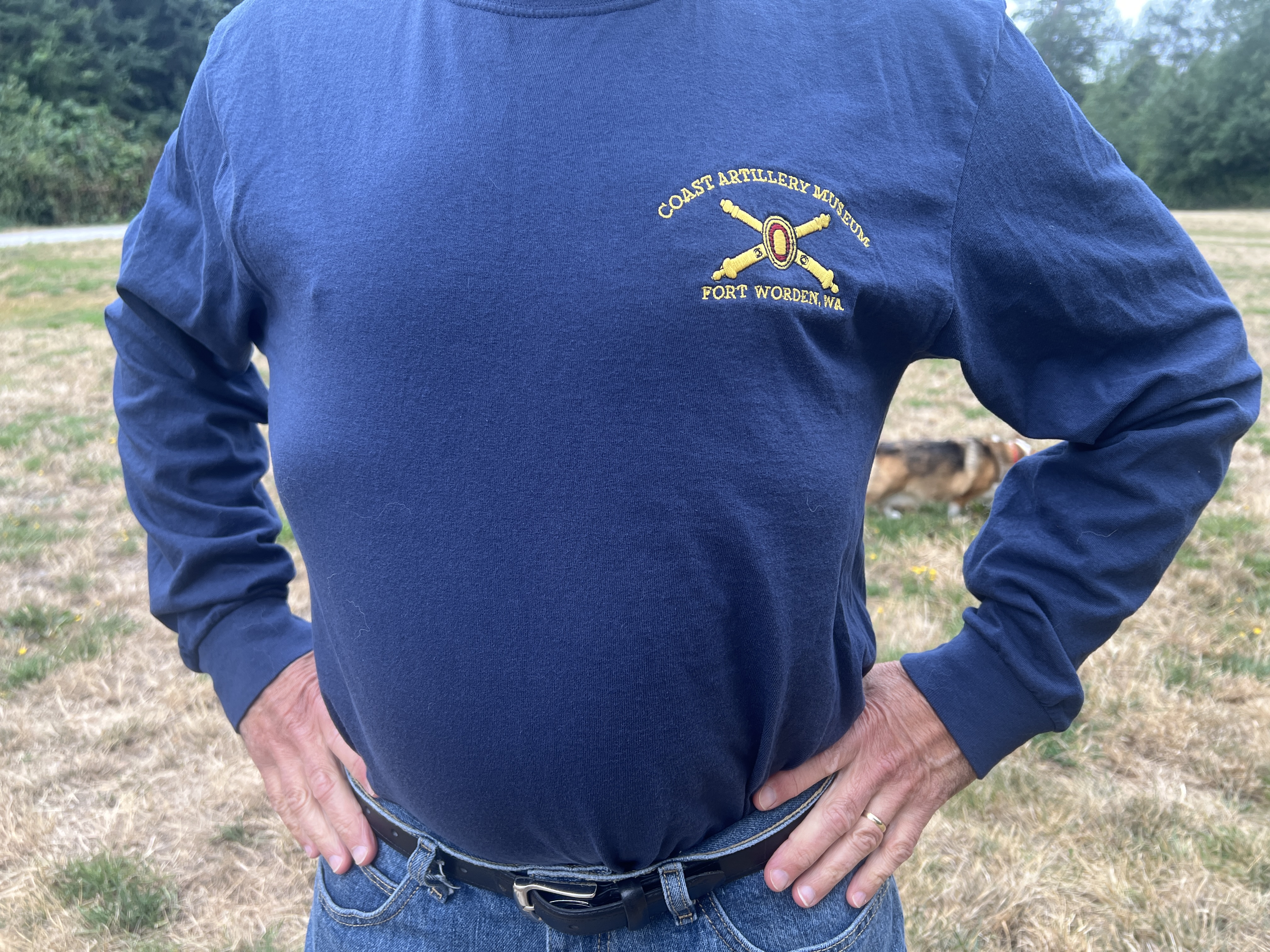
I bought this shirt for half price:
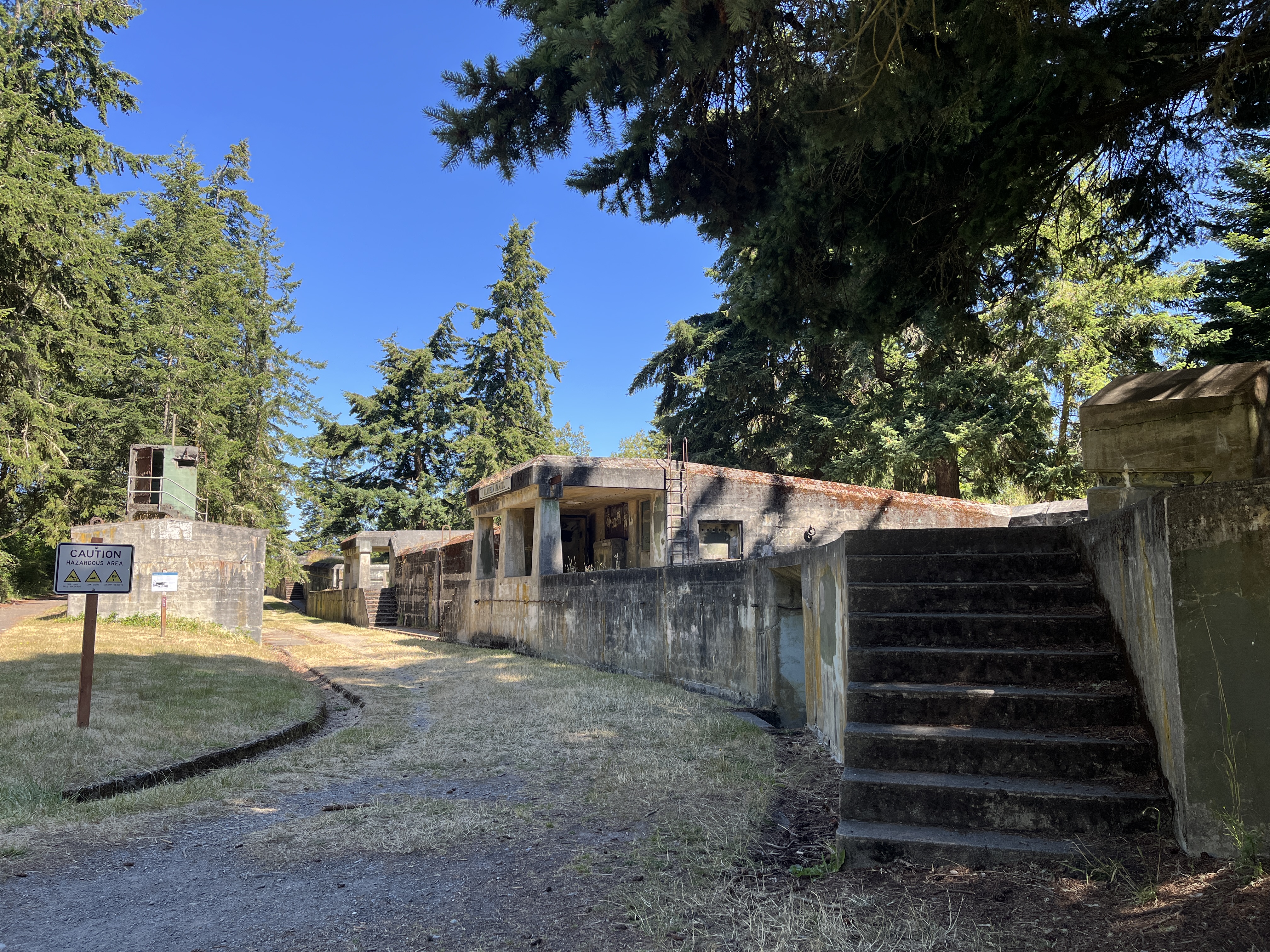
Below is one example of what they built in the 1900s to hold off unnamed enemies. The rooms beneath the fortifications are open to the public. How many teenagers have been deflowered in there?
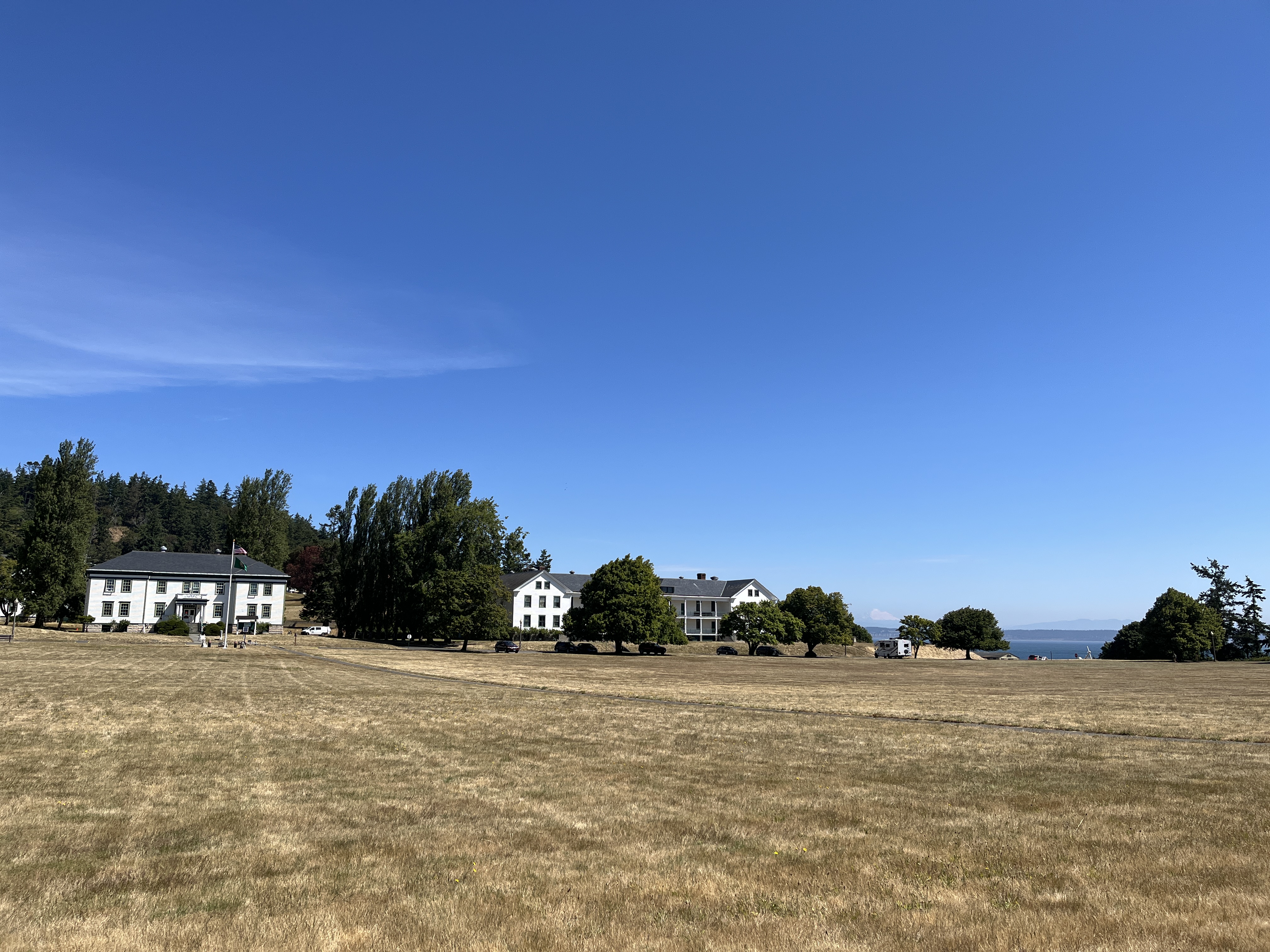
It’s about a mile around the parade ground. In the next photo, the barracks I stayed in is on the right. The cloud in the gap between the trees, to the right of center, is actually Mount Baker, far to the north of Fort Worden and just east of my hometown of Bellingham.
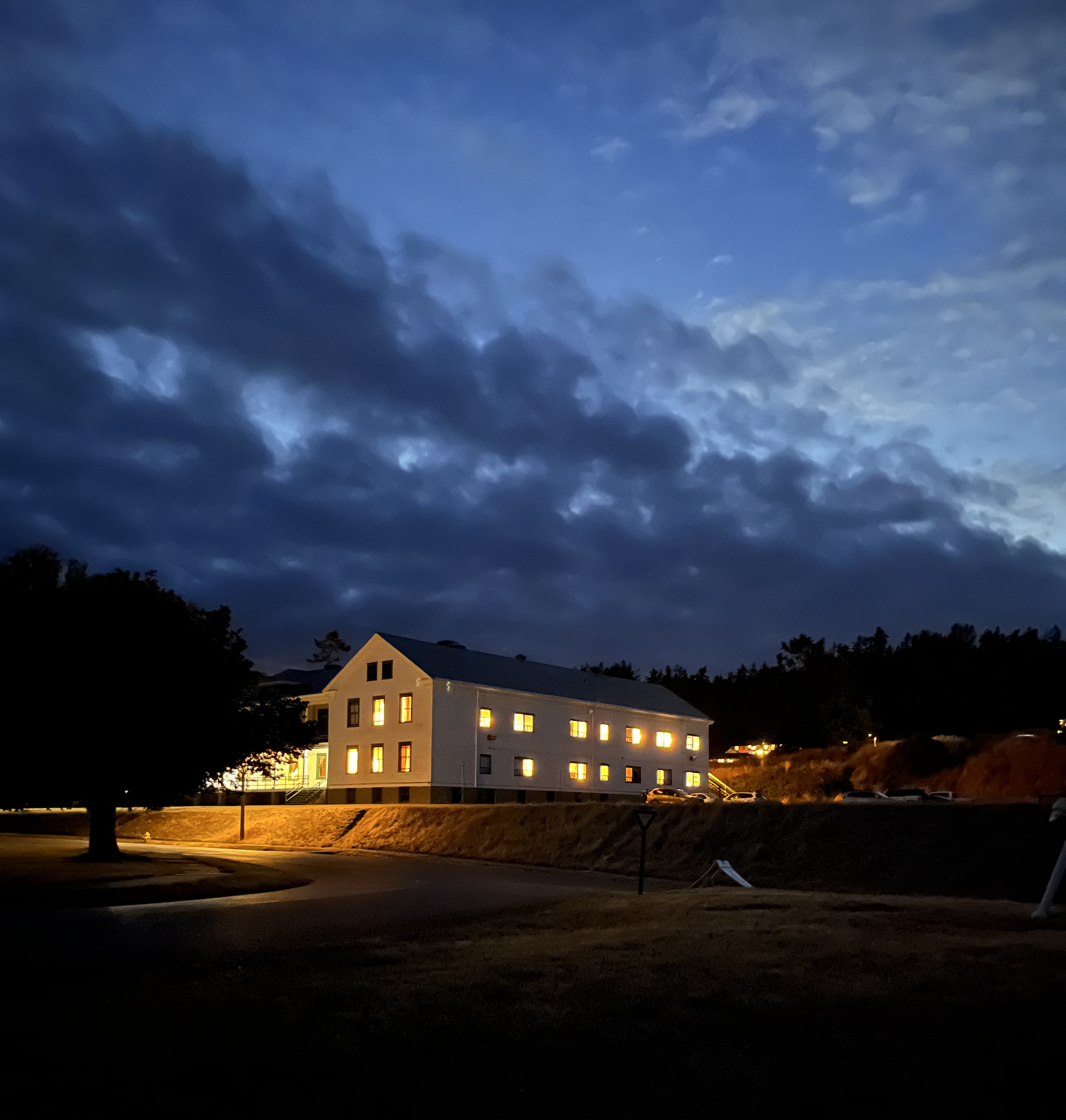
My barracks at night:
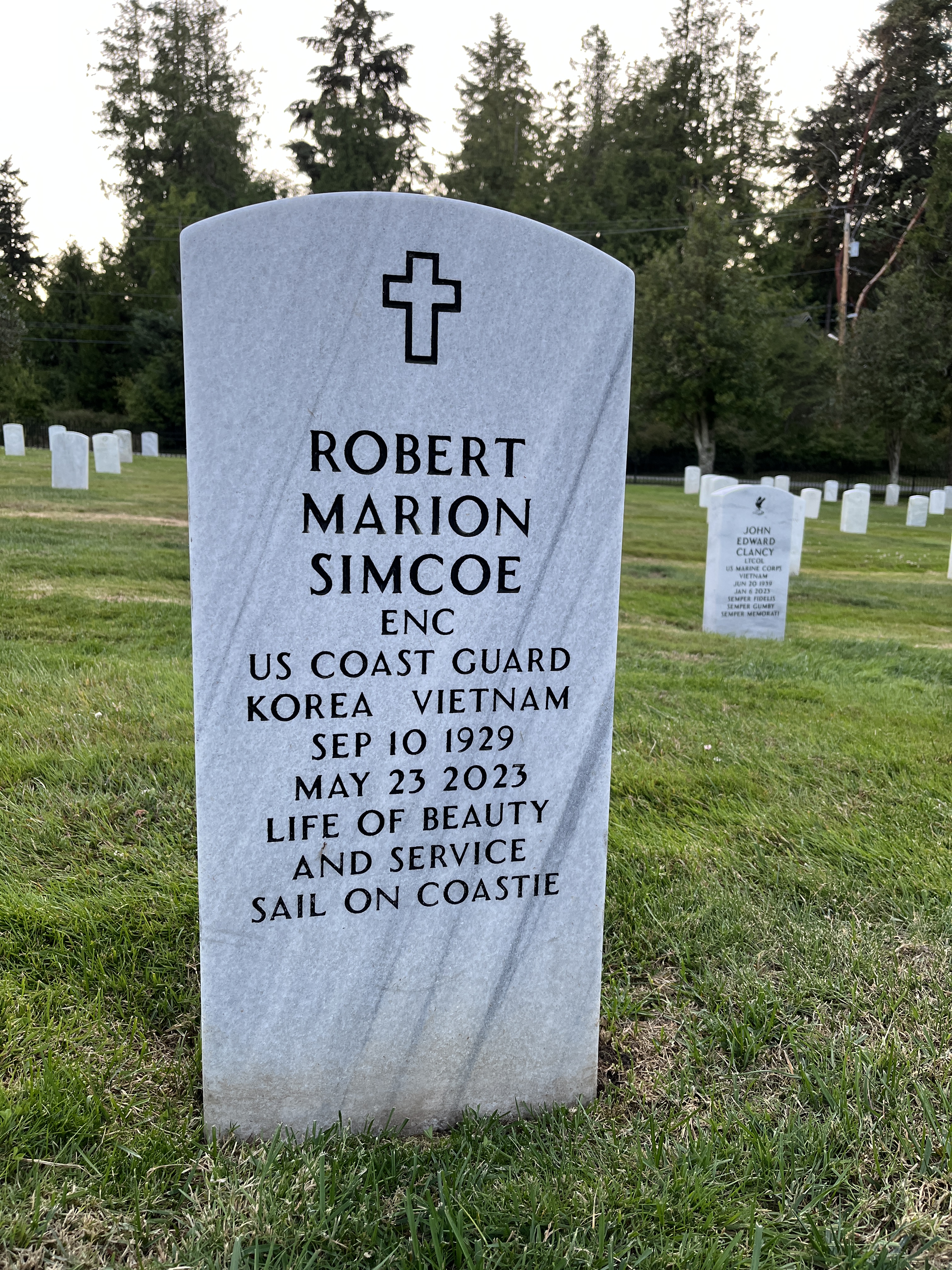
The cemetery, established with the fort, is still in use, for veterans and civilians:
I wrote a lot, learned to refrain from snacking because the cafeteria was closed between meals, talked poetry with the professionals, bantered with best-selling novelists, rocked the room on open mic night, and won the hand of a proud, aloof beauty named Willow. OK, the paw. Willow is a King Charles spaniel, though she might be part Pomeranian. There appears to be some disagreement on this point. I accept her as she is.
I’m happy to be home and ready again to dispense more half-baked wisdom!
My birthday season is in full swing and I couldn’t be happier. We ate dinner in our favorite Italian restaurant, where the food was fab and the waitress was stoned. “May I have a knife?” I asked her, because she had neglected to bring one. She replied, “Yes, for your chicken,” as if congratulating me for understanding utensils. Deborah, as if foreseeing this difficulty, had ordered something vegetarian.
We have a picnic with excellent old friends lined up for the Fourth. I have a writing conference lined up for mid-month, a sort of fantasy baseball camp where I won’t have to depend on my eye-hand coordination. Our main activities will be a) talking about writing, and b) complaining about money.
Meanwhile, look who else is having a birthday: The United States of America! Good work, everyone!
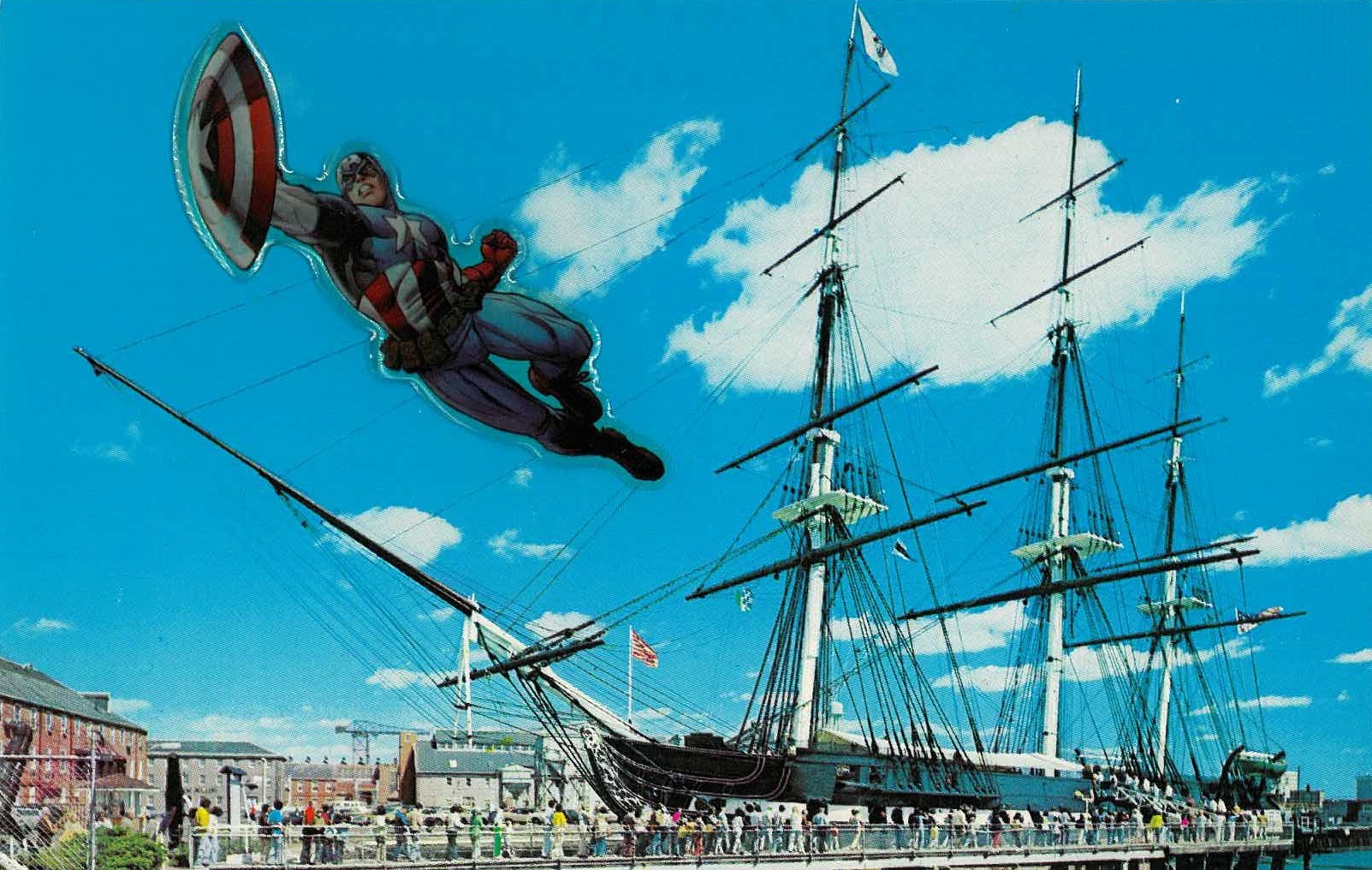
In honor of our nation’s birthday, and because I immigrated to this country from the People’s Republic of Massachusetts, I want to spotlight my favorite boat, the Constitution, as seen in this 1960s postcard from the Charlestown Navy Yard:
Like most things that were built in another century, it’s a miracle that Old Ironsides still exists. It is the oldest active-duty warship still afloat, in our navy or anyone else’s. (HMS Victory, Nelson’s flagship at Trafalgar, is still a commissioned warship, but the British moved her ashore after she was damaged during the Blitz.) For this miracle we can thank Oliver Wendell Holmes Sr. and a poem he wrote in 1830 when he heard that the Navy planned to decommission and scrap the Constitution:
Oh, better that her shattered hulk Should sink beneath the wave; Her thunders shook the mighty deep, And there should be her grave; Nail to the mast her holy flag, Set every threadbare sail, And give her to the god of storms, The lightning and the gale!
In 1830, this was incendiary stuff, and the public rallied to save what was quickly becoming a sacred relic.
On July 4, 2024, the Constitution appeared in the WordPress blog wwiiafterwwii. You may wonder why a sailboat launched in 1797 would appear in a blog devoted to 20th-century war junk. OK, it’s a stretch, but the blog’s creator, the anonymous jwh1975, used his post that day to celebrate our nation’s birthday by profiling the Coast Guard cutter Eagle and the Constitution. The Eagle was formerly a Nazi ship, so that’s her connection to the war. As for the Constitution:
On paper USS Constitution was the flagship of Rear Admiral Felix Gygax, commander of the 1st Naval District which had its GHQ relocated to Boston during WWII. Quite obviously it was not a suitable flagship for commanding the high-intensity, long-range conflict against Germany’s u-boats and was not used as such.
During WWII, the Constitution served as a brig and a storehouse for foreign flags and ceremonial swords. We all have a part to play in this life.
Today, the Eagle is used to train sailors in teamwork. The Constitution, however, simply exists:
USS Constitution is a fully commissioned, active-duty warship. The 83-persons crew are active-duty officers and enlisted sailors. Unlike USCGC Eagle which retains a utilitarian training function, USS Constitution has no mission of any sort. Congress funds its continued active service simply because American voters want this.
Happy birthday, everyone, whether it’s your birthday or not, and remember that telling your stoned waitress it’s your birthday usually results in a free dessert. Smooth sailing to you in the coming year. I’ll be back on Sunday, July 26, somewhat older but hopefully wiser. But I’ll still complain about money.
 Steven Bryan Bieler