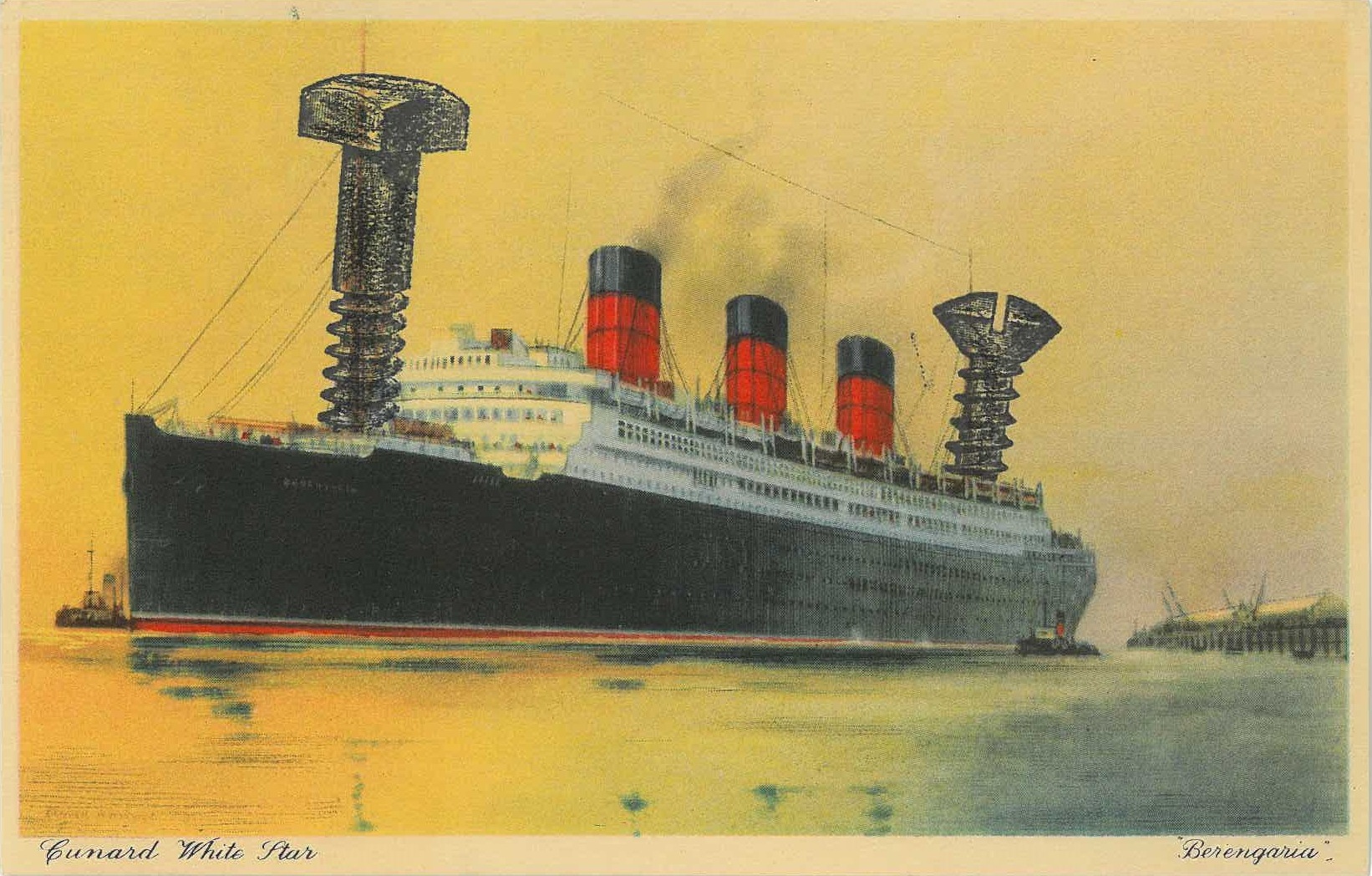
Counting down to my vacation (all I ever wanted).
RMS Berengaria had an interesting early life.
She was launched in 1912 as the German liner Imperator. She had some teething troubles, and was nicknamed the Limperator. After spending World War I heroically tied to a pier, she was seized by the victorious Allies. The U.S. used the ship to transport troops home from Europe. In 1919, she was handed over to the British government, who handed her off to the Cunard Line. Her first Cunard Line captain was Arthur Rostron, who captained the Carpathia when that ship rescued 700 survivors from the Titanic.
The Titanic, of course, was the definition of teething troubles.
Cunard merged with White Star in 1934, and the merged company retired the Berengaria in 1938, so there’s the date range for this postcard. Berengaria ran aground several times, and if you had her wiring in your house you’d keep a fire extinguisher in every room, but she also came to the aid of a foundering liner in the middle of the Atlantic.
I inherited the rubber stamps from my friend Jack, and he received them as unmounted rubber images, so I can’t tell you the manufacturer. Probably a company that went out of business in the 1990s.
Girl smashes chess barrier
In honor of today’s female theme, I am happy to announce that Bodhana Sivanandan, an 11-year-old from England, just became the world’s youngest Woman Grandmaster in history. She played first board for the English team at the Women’s Olympiad in Samarkand. In her 10 games she was defeated once, by the 33-year-old WGM Deysi Cori of Peru.
As a chess player, I am far above average. But if I were to play 100 games against Ms. Sivanandan, I might manage a draw or two. I might win a game if she got bored or wanted to watch Stranger Things or The Baby-Sitters Club.
Weird girls unite
Chess-playing girls are not weird. But there is today a literary trend called “weird girl lit.” “Weird girl lit” is a reader’s label, says agent Danielle Bukowski. “No deals in Publishers Marketplace have ever been announced with the phrase ‘weird girl lit.’ ”
Instead, publishers announce weird-girl books “for fans of” Ottessa Moshfegh, Mona Awad, Melissa Broder, and Jen Beagin, even though these authors did not choose this label. Just guessing here, but I’ll bet Ottessa, Mona, Melissa, and Jen call them “books.”
Bukowski: “Everyone generally understands a weird girl book to be about a young woman who can’t cope with modern life and makes a weird choice to try to evade conventional expectations.”
This sub-sub-subgenre has gained so much steam that it’s also gained a backlash. Bukowski recommends Jesca Dawn’s TikTok series “Weird Girl Lit that doesn’t center white women.”
When I told Deborah about this, she said it sounded like a High Times headline: WEIRD GIRL, LIT.
Gone girl
Berengaria (1165–1230) was a medieval English queen. She might have played chess, though if she had there wouldn’t have been a queen on the board. She might have written weird-girl lit. Who else in that era could read and write except monks and royals? She might even have taken an ocean voyage, as her husband, Richard, took her with him on the Third Crusade. He must have thought she was weird because he dropped her off in France.

