Thank God It’s Monday 13

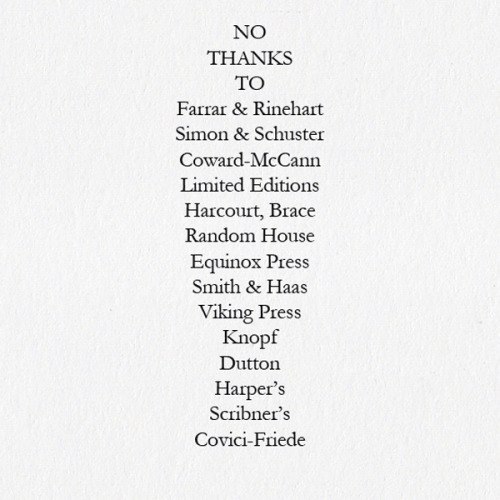
In 1935, e.e. cummings self-published a book of poetry. Because 14 publishers had said no thanks, he called the book No Thanks and dedicated it to the 14 of them:

cummings, who was very concerned about how his poems were displayed on the page,  produced this image on a typewriter. I know how to do that. You count the letters and spaces in a line, divide by two, and backspace backspace backspace from the center of the paper. It helps to only use lines that contain an odd number of letters.

There’s a lingering bitterness in what cummings did. Bitterness is useless. I get aggravated but I try not to be bitter. The 47 editors who rejected the story I wrote about in yesterday’s post might have done so because it wasn’t the sort of thing they publish. It was too long. It was too short. It was too Jewish. It was not enough Baptist. They had already read three similar stories. They were dealing that day with an audit, a toothache, or a bad love deal. Maybe they just didn’t like it. Whatever the reason, there’s nothing I can do about it…except copy e.e. cummings!

If at first you don’t succeed, try, try again. Then give up.

I just published a story called “Waiting for Mishy” in a magazine called Uncharted. I mention this for two reasons. First, I’m thrilled! Second, I want to briefly tell you the story of this story.

I started writing it in 2022. I finished it in 2023. I sold it in January of 2026. Uncharted posted it last week. By literary standards, that is faster than a speeding bullet.

And in the three years I spent trying to find a home for “Waiting for Mishy,” it was rejected 47 times.

Obviously, there are three things you need as a writer:

  1. A place and time to write.
  2. Persistence.
  3. An armor-plated psyche.
  4. When I first started writing, this list included typewriter ribbons.

You can do your life’s work in 30 minutes a day. You can do it in 15. You can write in a room of your own, at your kitchen table, at a coffee shop, in a library, or, like one writer I knew, in the back of a car.

You can write for a few years and then give up because everything is moving at about the same speed as a cat sleeping in a sunbeam. You can give up because you fear the rejection the way you fear the Reaper. Or you could follow Robert A. Heinlein’s fifth rule of writing: You must keep what you write on the market until it is sold.

[Note to the ghost of Heinlein: In 2021, I sold a story called “Schmitt Takes the Night Off” to The Buckman Journal (it’s behind a paywall) (not a problem for you, since you’re a ghost) that was rejected 69 times over 11 years.]

Rejection, I must remind you, is the river in which we swim. “You will write many more failures than successes,” Richard Bausch said. “You never ask yourself anything beyond, ‘Did I work today?’ ”

Or, as Jeff Lieber put it, “Write every day about something you give a shit about.”

Be patient.

I miss rejections!

I don’t miss the act of an editor saying “No.” What I miss is the hope. For example, starting the new year by submitting five stories to 25 magazines. Off they go, and I wait patiently to see which one will change my life.

Will a “Yes” change my life? I can think of two that did. The first time I sold a story, I decided to keep going. And years later, when I won my only contest, I decided to keep going. If I’m submitting stories, I’m part of a literary conversation, even if I’m the only one who knows it’s a conversation. It gives me hope. As Mr. Micawber said in David Copperfield, “Something will turn up.”

When I got serious about finishing the first draft of my novel, I decided to eschew distractions. I couldn’t eschew my wife and our dogs, but I stopped hunting down magazines and editors and submitting stories. In fact, I stopped writing stories. Been there, done that, went somewhere else.

And then I hit that point in the novel-writing game where you ask yourself, “What am I writing here?” And “What happens next?” And “What the fuck…” I didn’t panic. I knew I’d find my way. But I decided to fall back on something familiar.

I have two stories that have been sitting in limbo since the day I finished them. It could be that I never sold them because I think they’re finished but they really aren’t. I don’t know. But I’m giving them one last chance.

For story #1, I hired a service that reads the story, considers what I want (money and social media activity, primarily), and then recommends 10 places to send it. I attended a webinar run by the two editors running this thing and they impressed me. The 10 zines they chose surprised me. They were all lively, interesting, and appeared to be part of a larger conversation. This service cost me $50.

For story #2, I followed my usual strategy of choosing 10 places based on what they pay.

The way literary magazines work, some will be open for submissions when you visit their site and some won’t open until September. Some editors will respond to you within a week and some within a year. Most will say “No.” Stephen Marche, in a depressing book with the uplifting title of On Writing and Failure, wrote that “rejection is the river in which we swim.” He’s right; the majority of us will receive far more rejections than acceptances. Everyone else says to grow calluses; Marche says we should “relish the rejection.” Don’t go down that road. Note the rejection in your log or diary or scratch it into the wall and submit the next thing. Get back to work.

The lesson I learned from this exercise (this vacation from my book) is that I don’t want to submit stories anymore. It takes too long, even though they don’t call them short stories for no reason. They’re only a few thousand words each. A novel, a single work, suddenly seems simpler.

Well, I’ll let you know if I get any takers. Meanwhile, my break is over, and I am again forging–slowly–ahead. I just reached 56,004 words.
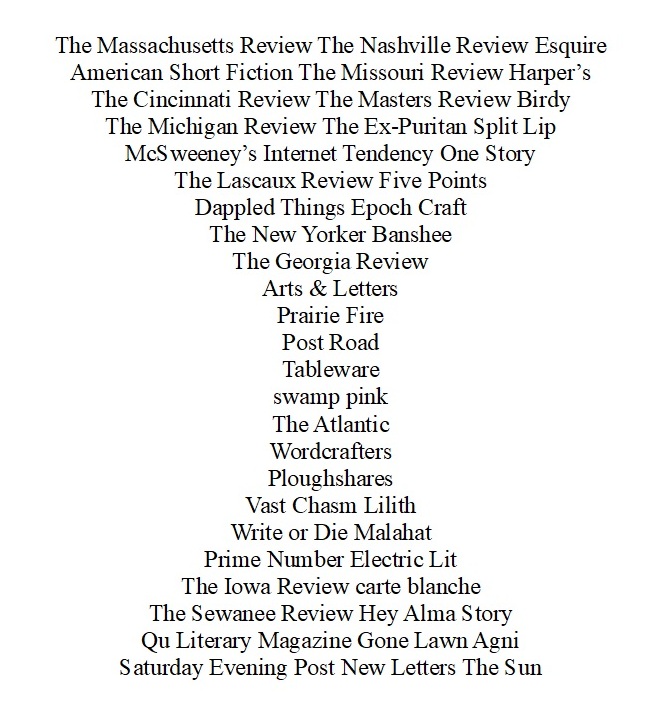
What to do with rejections

Writing is one of the best vocations you can pursue during a pandemic. Most writers are experts at self-isolating; at parties we’re happy to avoid the black-clad groupings and their brittle banter and instead hang at the buffet tables where we can stuff our pockets with spring rolls, meatballs, or whatever comes our way. Also, most writers make no money. Is the economy running wild? Is it hiding under the bed? It’s all the same to us.

Today we’re going to talk about rejections, the one thing the coronavirus can’t kill, though I haven’t received one since March 13. What can you do with rejections? In the 20th century I could tape them to the wall or fly them, on fire, out the window, but in the 21st century almost everything is automated, online, and impervious to sarcasm.

Professional writers counsel you to pay attention only to those rejections that actually say something about your story. Good advice, but the lengthiest rejection I’ve received in 20 years informed me that I am a misogynist. Is this why my wife moved me to the garage? She said it was social distancing.

I’ve discovered that there are only two things you can do with rejections.

  1. Laugh at them.
  2. Figure out how many rejections your accepted stories endured before they were accepted. Whatever the number is for your most-rejected, accepted story, that is the number beyond which you should never go.

In the last century, where I used to get paid for what I wrote, I never sold a story that had more than 10 rejections. In this century, where I don’t get paid for what I write, I’ve never had a story accepted that had more than 21 rejections. Therefore, by this reckoning, I should give up on any story that returns home with a dead mouse with that 22nd rejection.

As my Dad always said, “Do what I say, not what I do.” The story of mine that has received the most rejections from editors here in the 21st century now has 55 of the things…including the charge of misogyny and a confused note from another editor complaining that the narrator saw “harsh realities” as “humorous.” He didn’t say how misogyny fit into that.

But I still believe it’s a good story! I don’t care that it might chalk up another 45 rejections, assuming the coronavirus doesn’t kill off every magazine and website that publishes fiction. I can’t give up on it. But I still advise you to count your rejections and discover how your stories perform. My system doesn’t help me, but it might help you.

Days since last rejection: 5