The last time I took a typing test was in 1985. I was seated at an IBM Selectric and given a sheet of text to reproduce. I rolled a sheet of blank paper into that humming power plant and started typing. After the timer went off and my errors were deducted, I had hit 120 words per minute.
I may be off a bit in the year and the score, but you get my point. I was fast, even on the incredible hulks I grew up with. When I was inspired, I could produce a rolling thunder that drove my family to exile me to the basement. I tried a typewriter here in adulthood. I was already in a basement. My wife suggested the garage.
Computers make us all fast (the internet makes us furious). Here are the top three word-processing time-savers:
“Don’t think. Type.” I’m paraphrasing Ray Bradbury, who said “dream.” On a computer, you can type forever without stopping. On a typewriter, when you reach the end of a line, a bell sounds and it’s up to you to whack a lever so you can start the next line. We worry that computers train us, but look what a typewriter did with one little bell!
The magic of the backspace key. Changes cost nothing. “I can’t write five words but that I change seven,” Dorothy Parker lamented. If you could’ve given her a laptop, she would’ve given you the chair next to her at the Algonquin Round Table.
Global search and replace. With a computer, if you decide some paragraphs are in the wrong place, you highlight ’em, cut ’em, and drop ’em somewhere else. Easy. With a typewritten manuscript, you cut up the pages, throw away the extraneous parts, do some rearranging, and tape the thing back together. Want to get fancy? Run your taped-together monster through a copier to make everything cleaner so you can start cutting and taping all over again.
Does all this sound like I am dancing on the grave of the typewriter? I’m not dancing on anything unless you’re playing Duran Duran. And anyone who has ever corresponded with me knows that I love typewriters. The monthly Typewriter Afternoon at our library leaves me quivering with antici…pation. I am in awe of the intrepid woman who lets the public use her machines.
Typewriters: Letters, yes. My novel, no. Writing fiction is slow enough.
Historical note 1: The science fiction writer Frederik Pohl claimed that he wrote a story in 1936, sold it in 1937, saw it published in 1938, and was paid in 1939. This is not too far off from the experience of writers today, except for the getting paid part.
Historical note 2: In 1990, I took my typewriter to my regular office-supply store in Seattle. It was the last place in Seattle that serviced typewriters. They turned me away. They were done with typewriters. The improbable typewriter renaissance was still years in the future. I sold my typewriter at one of our yard sales, to a college student who wanted to live in a garret and starve and all that other writer stuff. The black plastic carrying case had some of my best stickers on it.

I sometimes think of my Smith-Corona. If I had kept it, by now it would’ve racked up decades of hibernating in a closet. As much as I love typewriters, I would consider it a life-changing inconvenience if I had to return to one. But I can’t deny the joy of hopping from one typewriter to another, from an armor-plated behemoth that has survived the journey from the 1940s to a svelte greyhound from the 1970s.
“To this day I think my best work came from the Selectric. Like others, I would plan an article in my mind or even outline it on paper. Then I would type it in one fell swoop with almost no changes. Today I stare at a screen and then start typing, go back, and edit and edit. I am more apt to try to proofread on the screen rather than the printed page as I used to. I know I caught more problems the old way. The new way may be flashy and modern, but the old way was better.”
This quote is from the essay “Requiem for a Typewriter” by Frank Romano. It appeared in Electronic Publishing in September 1995. I can’t find the essay online (Requiem for a Typewriter is a 2024 album by Bad News), there are many Frank Romanos who write (the Wikipedia listing is for a bass player), and Electronic Publishing is no longer publishing. Robert J. Samuelson wrote a similar essay with a similar title in Newsweek in the same year. It was an inevitable topic back then.
I understand Mr. Romano, but if we could ask him today, would he still claim “the old way was better”?
It wasn’t better. It was just different. And, at least once a month, incredibly fun.
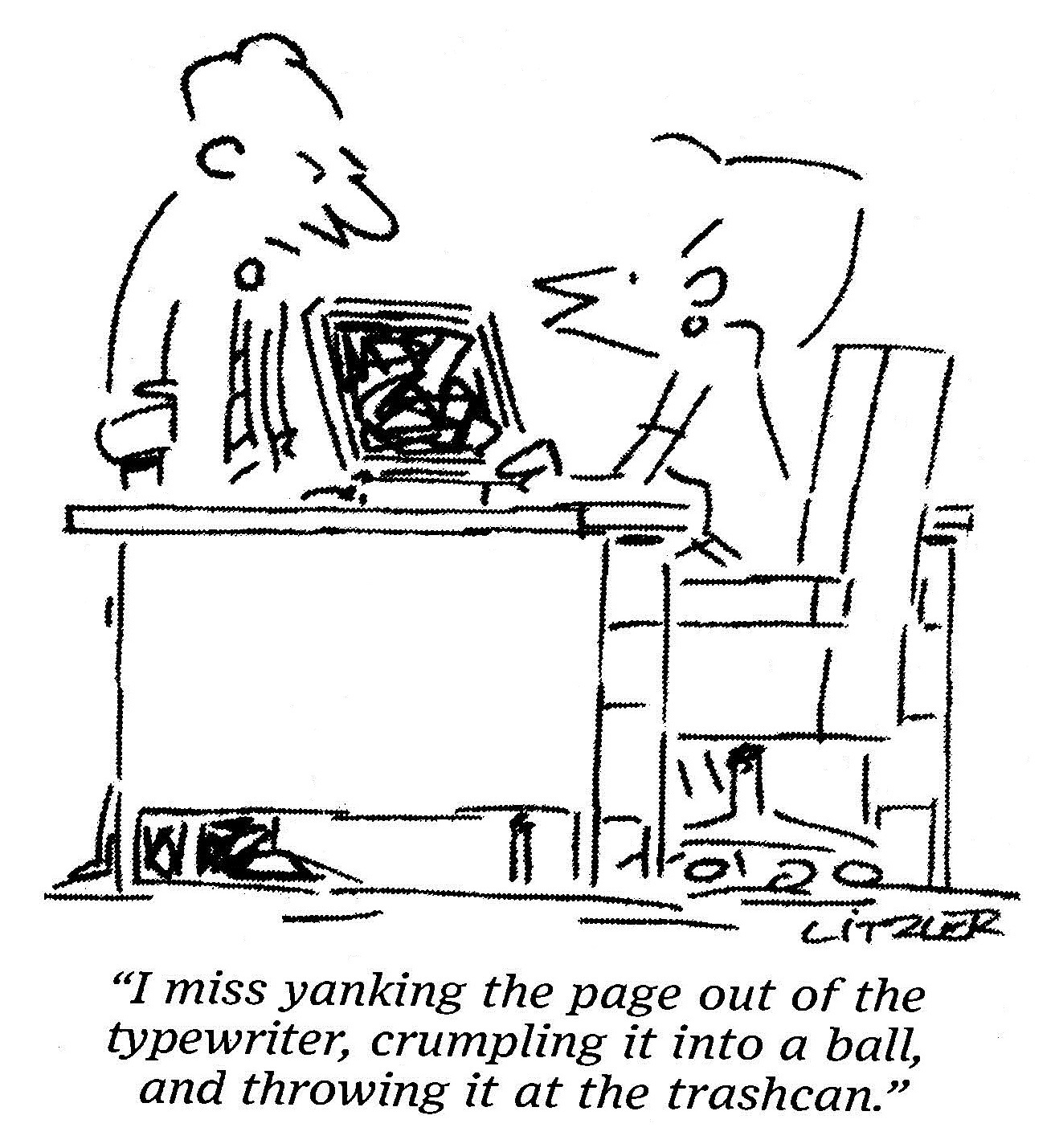
But if you really want to talk Old School: There’s nothing like pencils.


I haven’t seen your little video about rubber stamping on old postcards. Excellent!
I always appreciate it when you youngsters write in. That video was part of my attempt to go viral. My eight videos proved to be some of the top videos in popularity. Together they racked up 1,712 views…in only 13 years! For the record, here are my videos in order of visits:
1. “Rubber stamp your old postcards”
2. “Rubber stamp your old postcards 2.0”
3. “Rubber stamp your old postcards 3.0” (apparently, people got tired of this shtick)
4. “New corgi reports to training camp” (the students at Reed College put this one over the top)
5. “Corgi teaches social distancing”
6. “Lucky plays defense against Mr. Hose” (for anyone who loves Gardeners’ World on BritBox)
7. “Northern flicker throws down” (bird versus office worker)
8. “Xmas train daylight ride”