Masking is how you block part of a rubber stamp’s image. The simplest way to achieve this is to place a thin sheet of paper (the mask) on the work surface, then stamp partway on, partway off the mask. Tracing paper works best, but pages from The New Yorker also work well. Your biggest challenge is alignment.
There are other ways to mask an image. You can stamp it onto a Post-it, then cut the image out of the paper. For the Giant Breaker Robot below, I used tracing paper to trace the breaking wave and the rocks and cut out the outline. I positioned the outline on the postcard, then stamped the robot. Most of his legs and one hand (appendage?) stamped harmlessly onto the tracing paper.
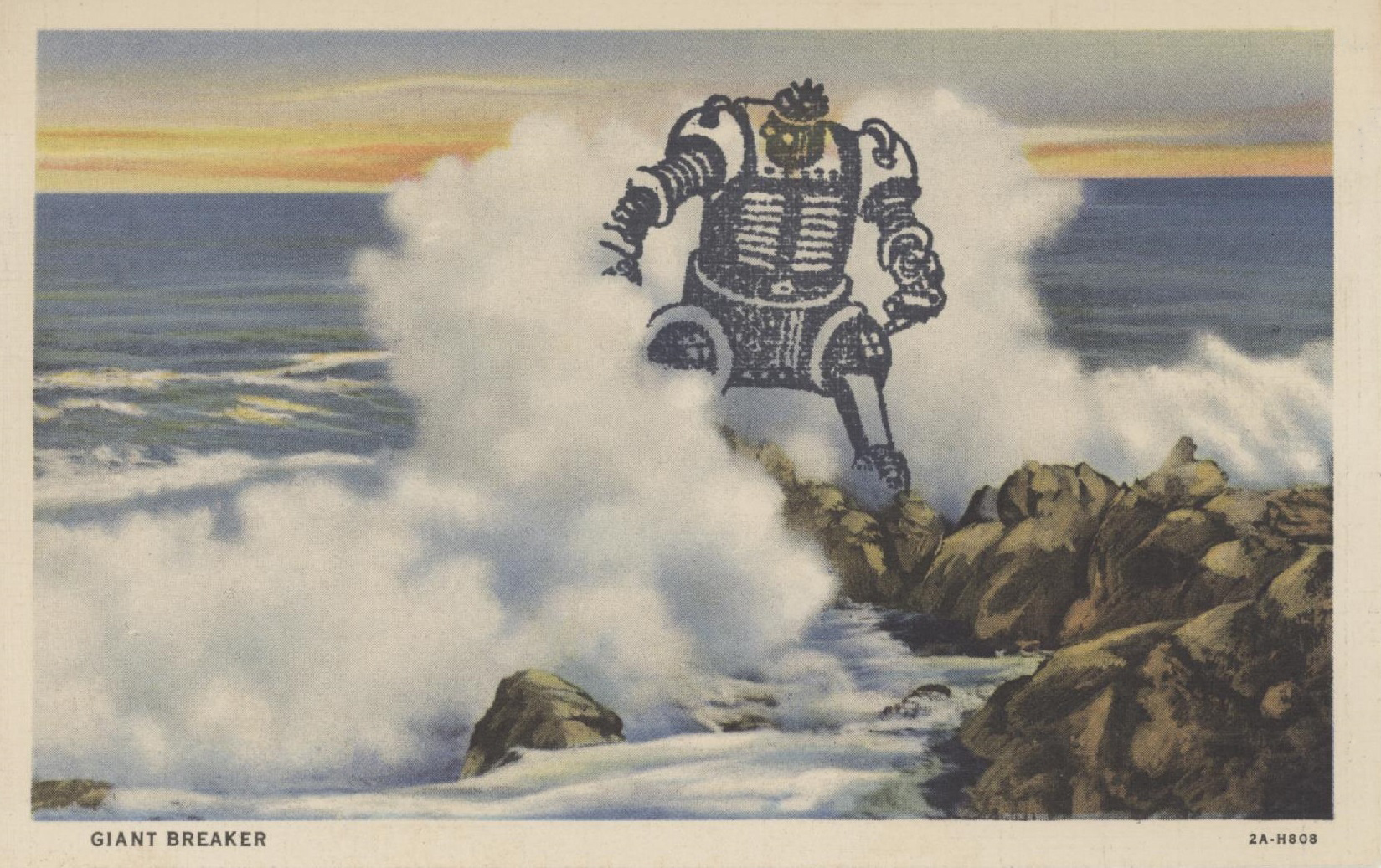
Mr. Robot (if he were a she, she wouldn’t be caught dead with hair like that) was made by Namz Rubber Stamp Co. He is one of my most useful stamps. He takes colors well, even if you just want to dot his eyes with red. But after I saw how he looked in the breaker, I left him alone.
This postcard of a generic surfside scene was published in the 1920s or 30s. Collectors call this type of card a linen, as it’s cardboard but with a textured finish. Linens are the most desirable cards for defacing. They take stamp-pad ink, colored pencils, and markers well, and they usually have vibrant colors because they started out as black and white photos that were then hand-painted. Linens are cheap. That’s good, because you’ll ruin plenty of them.
Footnote: If you’re not happy with a particular stamp, consider altering it. I had a stamp of a hair dryer trailing wild loops of wire. The hair dryer could’ve been any hair dryer, but the wire looked evil. I finally carved the hair dryer off with an X-Acto knife. Then I had a high-tech snake. Perfect.
 Steven Bryan Bieler, Writer