Day 3: Cranberry scones of death

Happy fattening birthday, bitches.

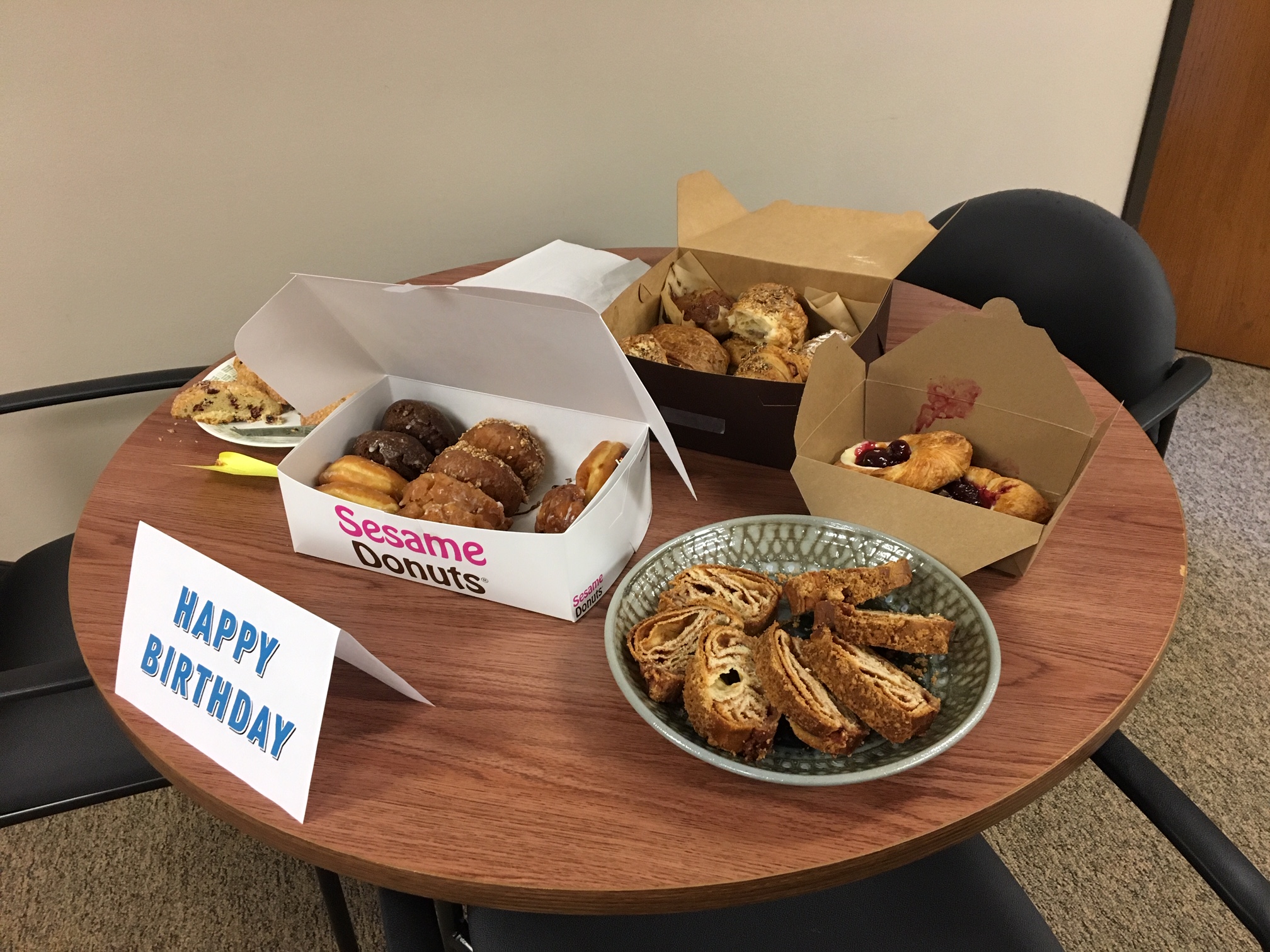
Not much progress in the Write-a-thon today. Three of us in our department had birthdays (one last week, one this week, one next week) and the apocalypse of pastry brought in to celebrate was placed on a table by the door to my office. My discipline and self-esteem immediately left the building. Plus we all went out for a Caribbean lunch. By 2 p.m. I longed for a hammock under my desk like we used to have in software.

You are what you eat, and if you eat like this you’ll demote your brain. The rest of you won’t be happy, either.

My lone accomplishment today (though still satisfying) was to finish rooting out all the false starts, cul de sacs, potholes, critiques of versions that no longer exist, and other irrelevancies that form the archive to a book I’m nowhere near finishing. I shredded the paper and deleted the files. I am not the Smithsonian.

Diet Day 3

Looks like I’m not 25 anymore.

Greetings, Eastern Europeans

After every post, half a dozen bloggers from the countries that once were trapped behind the Iron Curtain like and/or follow me. From their photos, I can tell they are 25 and they can still eat like that. I’m glad you’re enjoying yourself. As soon as we reach our cruising altitude you may move about the blog.


Clarion West, Day 2: The cult

No, I’m not talking about the English goths who made a lateral career move into stadium butt-shaking. I refer instead to a subclass of railroad enthusiasts who enjoy sneaking into railroad facilities and risking arrest and bites from angry watchdogs to photograph equipment that looks like, well, equipment.

These are men who can look at a passing line of tank cars and tell you from the number on each car where they’re from and where they’re going while the rest of us are worried that all that gasoline is going to blow us to the Yukon. These happy-go-lucky hobbyists are what professional railroaders call FRNs: Fucking Rail Nuts.

I mention this because yesterday I said I’m writing a book full of trains. Another gentleman who wrote a book full of trains, Carlos A. Schwantes, was besieged by FRNs as soon as he went on the road to promote Railroad Signatures Across the Pacific Northwest. This is a book about the impact of the railroads on urban and rural areas and what happened when, in many places, the trains stopped running. It’s full of old advertising, memoir, maps, and cultural and economic analyses. But Schwantes could not escape the FRNs who assumed he had counted all the rivets in a steam locomotive, all the wooden ties under the tracks, all the bridges of Madison County, and other burning issues of the day.

I am not writing a book for rivet counters. My target audiences are my wife’s book clubs, past and present. I have met these women and I can tell you plain that not one of them knows the four types of stresses on a railroad bridge, and yet their lives run along just fine, thank you very much.

Today, after working on one unified chapter 1 from three variants, I cleared out more of the stalactites of surplus language in the cave of literature. In my piles of notes I found I had written a job description for a job that’s probably not going to be in the book and even if it was who is going to apply for it, a reader? Also some songs, critiques of chapters from critique groups I was in years ago, and, of course, erotica. Can’t have a book with trains in it without erotica.

Tomorrow, some thoughts on protagonists and the novelist Kent Wascom, who, on the advice of his mentor, kept 90 pages of the first draft of his first novel, The Blood of Heaven, and threw away the other 600. Frankly, I don’t have that kind of time.

Diet Day 2

There are entire nations that don’t know where their next meal is coming from, and here I am complaining because there’s too much food coming my way. This problem would be incomprehensible to approximately 2 billion people.

The trick to dieting is filling your stomach with something that makes you believe you’re full but something that is not donuts. For a while I experimented with frozen corn and peas mixed with cut-up pieces of protein, such as chicken or sasquatch, then microwaved. Not bad, but these simple lunches required seasoning. All the seasoning. There’s actually not enough seasoning. I have returned to the test kitchen.

FBI Special Agent Dale Cooper said, “Every day, once a day, give yourself a present.” Permission to transgress once may be the best dieting advice ever given.

I came to plié

The Clarion West Write-a-thon began today. I promised that I would blog about it every day, no matter how much I blood I lose.

Here’s the situation: I’m writing a book about working for a living, except unlike the offices I usually write about, this story is set in 1947 on a railroad in the mountains. I have a hero who’s going to have to learn a thing or two, the woman he’s focused on, the woman he should be focused on, allies, villains, mentors, bystanders, eccentrics, philosophers, misguided twits, and, of course, trains.

But I’m stalled.

I have seven chapters, about 28,000 words. I have 22,000 words in my notes, including three obituaries of my characters (one of which is one of the best things I’ve ever written), and a fake bibliography (it was fun). I’ve written three short stories based on this book. I even have an alternative chapter 1 where I try a different point of view. And then there are all the maps, charts, photos, and postcards I’ve collected for — inspiration?

As you can see, I’m doing everything except writing my novel. I think there are three reasons for this:

  1. I don’t know how to do this. I’ve never written a novel before.
  2. Sloth.
  3. The thought that even if I finish, I will never publish this book anywhere.

As for that third point, I have some evidence. Yesterday one of my stories was bounced from Glimmer Train. (More about this magazine in another post.) That is my 175th rejection in this century.

I’ve never received a single rejection for a novel, because I’ve never written one. I should write one. Public accountability will help. Thanks for reading along.

The two deadly sins: writing and eating

Some guys turn to alcohol when they’re stressed. Some turn to Coldplay. I eat. This morning before we went hiking in the Columbia Gorge I stepped on the scale and the scale glared at me and said 170.8. That might seem like nothing much for a man who is 6’7″, but I’m 5’7″. I was in better shape than this not too long ago. So here is how I’m spending the next 41 days: making things up and not eating.

Clarion ends on August 3. My overarching goal is to still be alive on that sweet Saturday.

See you tomorrow.


You can have a writing life or you can have a clean house

The 2019 conference of the Association of Writers & Writing Programs, held March 27-30 in Portland, Oregon, was fattening. There were more than 800 exhibitors in the conference expo – indie publishers, small literary zines, editorial services, and a guy who was selling concept-coded dice to help kids write poetry – and most were handing out lollipops, bite-size candies, or chocolates. Except The Paris Review, which had croissants. The expo space, large enough to hold half a dozen defective Boeing airliners, was full of good things to read and bad things to eat.

AWP offered hundreds of panels and workshops over three days exploring every aspect of gender, race, identity, mainstream voices, marginalized voices, writing, publishing, and teaching. There were also more than a hundred off-site events. “This reading will eat you alive,” a smorgasbord of 16 writers promised, while The Cincinnati Review and two other litmags from the heartland billed themselves as a clash of the “Monster Mags of the Midwest.” The off-sites popped up in bars, restaurants, hotels, coffee shops, bookstores, Mar-a-Lago, and on the International Space Station.

This was not just a writing conference. This was an event.

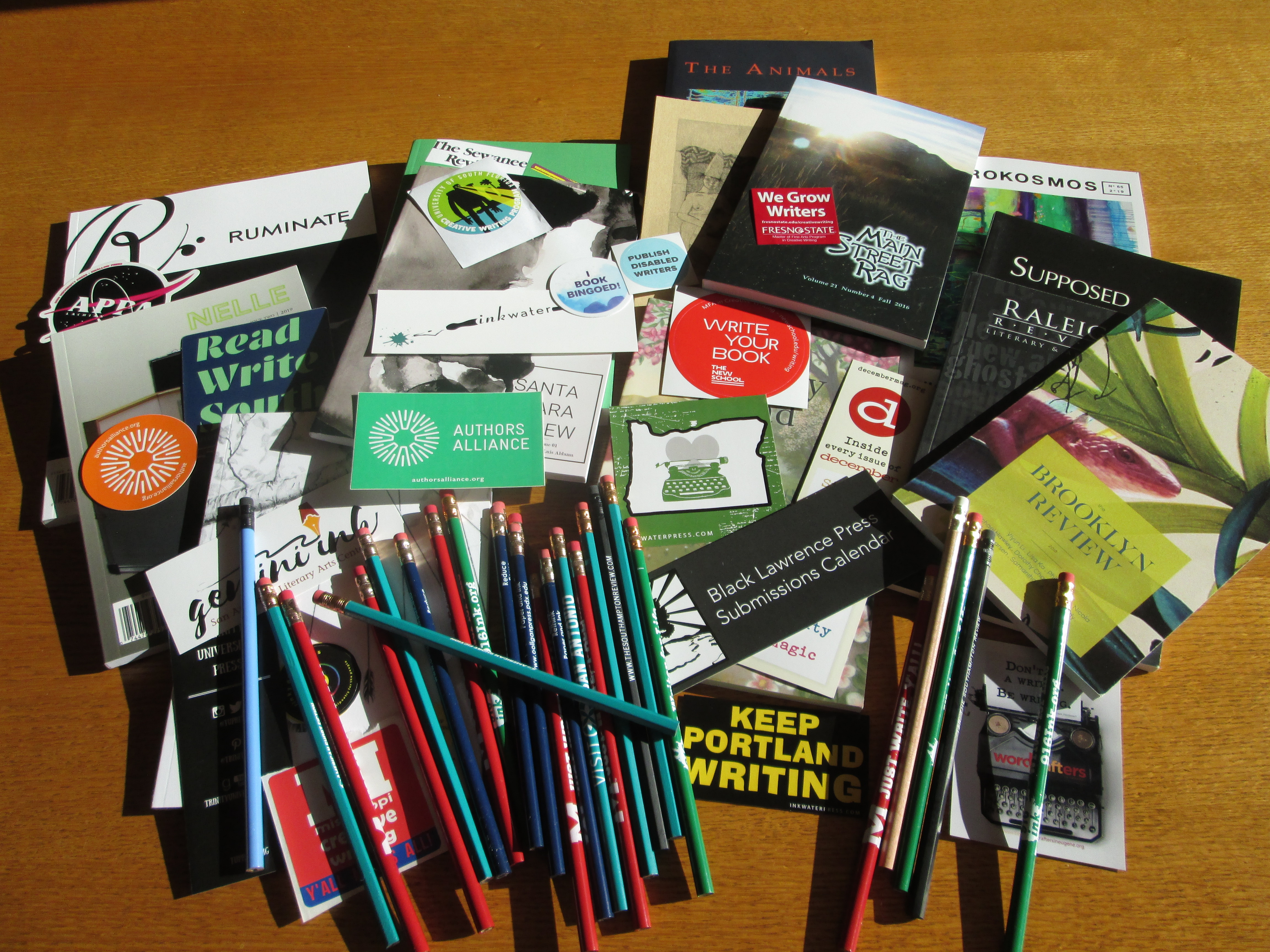
The only day I had was Saturday, and the only time I had covered 0.75 expos, three panels, and one reading (female science fiction writers of the Northwest). What follows is my report, with tips on writing. But first: Merch!

Secret expo missions

I entered the expo with two goals: stripping the place like a one-man plague of locusts and getting my photo taken with every editor of every litmag that has rejected my stories. There were plenty of candidates: Ploughshares, Tin House, McSweeney’s, Paris Review, The Sun, etc.

The latter plan proved to be unworkable. Either there were no editors present, or the editors were busy, or the editors were 10 feet tall with lightning bolts idling around their heads (cf. Ploughshares, Tin House, McSweeney’s, Paris Review, The Sun).

Or I scared them. At the table for The Bellingham Review and the MFA program at Western Washington University in Bellingham, Washington, I jauntily said to the two 20something women running the place, “I have so many rejections from The Bellingham Review!” I probably don’t have more than three, but I’m a big tipper. One woman was a student, the other was recently a student, neither was an editor, and both looked stricken, as if I had declared, “My name is Inigo Montoya. You killed my father. Prepare to die.”

Fortunately, I’ve made enough verbal gaffes since I first learned to talk that I know how to put the helm over and tack toward safety. I’m familiar with Bellingham, and soon the three of us were safely chatting about Western’s campus, Village Books, and Lake Padden. They gave me a copy of The Bellingham Review. Maybe if I actually read this issue, I’ll write something the editors like for a change.

My other expo mission was a success. This being the last day of the conference, no one wanted to lug all those magazines, books, and other paraphernalia home. Everything was on sale or, failing that, they’d just give it to you. Although now that I’ve been woked by AWP, I wonder if the gross tonnage of stuff I received was directly proportional to me being a clean-shaven, middle-aged white male in a sport coat.
Beats the crap out of the Associated Press lip balm they were handing out that weekend in Providence, Rhode Island, at the annual conference of the American Copy Editors Society.

I had to make an extra trip to the parking lot to stash everything in my car. There were no AWP off-site events going on in the back seat.

Now you – yes, you – can become a famous writer just like me

I went to three panels:

  • “You’ve Got This: Finding and Sustaining Self-Reliance While Writing a Novel”
  • “Surviving the Writing Life: Whither, Life Balance?”
  • “Listening to the Art: Committing to Your Book No Matter How Long It Takes”

The panelists and moderators had all come from academia and MFA programs. Reading their credentials in the program book made me feel as if I had come from a mall. However, no one demanded my passport or asked me to explicate a canto, and I learned a lot. I was particularly impressed by the moderator of “Listening to the Art,” Cara Benson, who kept things moving. And hopping. She is exactly the kind of person who can commit to her book no matter how long it takes.

Here are some notes I jotted down while juggling merch and, during one panel, my sandwich.

How to get shit done

A young father said that sometimes you have to neglect your family to advance your writing. “I tell myself, this week I’m going to be a bad dad,” he confessed. “I’ll make it up to them next week.”

One panelist told us about a woman who works on one novel in the morning and another novel in the afternoon. Eventually, one project pulls ahead of the other, and that novel becomes the woman’s focus. (There was no explanation of how she makes a living. Morning novel, afternoon novel, evening shift driving a bus?)

Plan your week. Buy the biggest white board you can find.

Hold yourself to a weekly word or page goal. Colson Whitehead, the conference’s guest of honor, said in his keynote speech that his writing goal is eight pages per week. There’s no magic number, a panelist said. Just pick a number. Any system that works for you, that results in you getting words on a page, “even shitty words,” is the system for you.

Everyone agreed: Don’t waste time rewriting first chapters. One of my toughest challenges. Everyone also agreed: Don’t waste time with writing software. Just write.

Crash Davis to Nuke LaLoosh: “You have to play this game with fear and arrogance.”

Be ruthless. If something isn’t working, throw it away.

Corollary: Once you’ve written 50,000 words, even if you throw them away, writing a novel won’t ever intimidate you again.

Addendum: Do you have a novel fragment hanging around? Throw it out – or finish it by any means necessary. “Dragging things out results in poor writing,” one panelist said, while another adjured us to “show up for the page.”

What kind of beast are you writing?

How can you tell if the story you’ve begun is a story or a novel? Stories close. If your story won’t close, it’s probably a novel.

You never come out the way you came in

A quiet but forceful woman, speaking from lengthy novel-writing experience, said that every project needs something different from you. By the time you finish your novel, you are the writer you needed to be on page one to write the novel. Then you start the next novel and you’re starting all over again. But you finished a novel and that knowledge will keep you going.

Fail whale

A 60-year-old mom of grown children said, “It is what it is. I don’t write fast and I get rejected a lot. My novel took 30 years to write because I got it wrong so often.”

“You have to fail so hard and so often,” another writer said. Her first three books failed, but books 2 and 3 failed faster because she gave up sooner.

Carve out the time. Pick out a project you can commit to for years, knowing that you might fail.

Listen to what calls you, but don’t be wedded to an outcome. “You’ll get to your next set of obsessions.”

My new mentor

The youngest panelist on all three panels was 25. She works at Powell’s City of Books. In fact, she was working at Powell’s that day. With her supervisor’s blessing, she jumped on a bus to the Convention Center to get to this panel. After the panel, she was heading back to work. Until her next panel.

Despite her up-talking and and the way she filled every sentence with like like like like, she was a great writing coach:

“Just write a shitty first draft. At least then it’s done. Five words or 500, you’re doing it. Those five words weren’t there yesterday,” she said. “As long as you’re writing something you care about, that’s the best thing you can do.”

Can’t touch this

One of the panelists told us that he’d been in recovery for alcohol and heroin addiction. In response to a question from the audience about writing after recovery from addiction, he told us, “Recovery is not for the people who want it or need it or deserve it. Recovery is for the people who do it.”

I didn’t buy a white board, but if they had been giving them out in the expo, I would’ve grabbed one. Writing is for the people who do it. It’s time to show up for the page and fail. Or to get shit done.
Writing, as everyone knows, is simple and fun

If the soaker hose you so carefully set into the garden in April when nothing is growing springs a leak early in its run, the plants near the leak thrive and everything at the back turns to potato chips by July. That’s what’s happened to my writing blog. It’s what’s happening to my novel. My music blog and various activities that are more fun and less work are drinking all the water.

It’s time to repair the hose. It’s time to give the back of the garden the same significance as the front. It’s definitely time to stop torturing this metaphor.

In July, I published a story in Across the Margin. I sent a story to a magazine, and the editor wanted it. The last time I published two or more stories in the same decade was the 1980s, when I was writing science fiction and fantasy. I was happy (and surprised) when Michael Shields, the editor of Across the Margin, asked if the story was still available, then read it and praised it.

I’m unaccustomed to success. I’ve collected enough rejections in my writing life to get a major depressive disorder named after me. What do I do now?

How about plunge back into my novel? How about use this blog to push myself?

That’s the plan then: Write. Simple? We’ll see! In this space I’ll report on my progress and on the books I’m reading that illuminate writing in some way.

The title of this post is not original to me. Here’s the full quote, from 1970s era science fiction writer Arsen Darnay:

Writing, as everyone knows, is simple and fun. The ideas come, you jot them down, and pop the pages in the mail. Three days later, a breathless editor calls to say ‘Yes!’ That in a nutshell is the common experience.


Recommended reading #1

Thanks, But This Isn’t for Us: A (Sort Of) Compassionate Guide to Why Your Writing Is Being Rejected
Jessica Page Morrell
2009

There are more books on how to play chess than there are books on how to play all the other games ever invented. The first book that William Caxton ran off his printing press was the Word of God. The second book was several thousand words on chess.

I can’t make the same authoritative statement about books on how to write, but I’m willing to wager there are more writing books than there are painting books, sculpting books, sewing books, etc. Plenty of people think they know how to write and plenty of them are convinced that they should pass on that knowledge. Most of these people are wrong.

Not Jessica Page Morrell. Thanks, But This Isn’t for Us is a no-illusions guide to writing fiction (and, to a lesser extent, memoir). If you’ve been writing long enough to really get bloodied by uncooperative characters, plot holes you can’t plug, stacks of rejections, and bare-knuckle writing workshops, you’ll know most of what Morrell presents here. But you might not have stated it with her punch and pith.

“Fiction is about interesting people in a mess of trouble” is the most economical definition I’ve read, but just as William Strunk balanced his verbal frugality by repeating everything, Morrell reminds us later that “fiction is messy, a smackdown or battleground.”

Stop arguing with yourself
Morrell was inspiring for me because I’ve been slowed to a zombie-like stagger in the first draft of my novel by my need to perfect every scene. Instead of writing new chapters I keep revisiting old ones. Morrell basically told me to shut UP. “Your inner editor is clear-eyed, helpful, and sane. Your inner critic is sneaky, undermining, and nutty,” she writes, then advises us that, rather than passively listening to our inner critic, we should “engage it in a dialog.” Instead of always noticing your mistakes, focus on what you’re doing right.

Remember: “…the purpose of your first draft is to cling pitifully to life until you have the time, stamina, and insight to revise (or revive) it into a respectful rendition of itself.”

Morrell’s idea of what works in a novel can be formulaic. She doesn’t account for the success of unconventional writers such as Toni Morrison, Haruki Murakami, William Faulkner, etc. But like any good chess player, Morrell is playing a larger game. She wants you to learn the rules before you break the rules.

Calm down
She also wants you to take it easy on yourself and have fun. After all the advice about plot, conflict, suspense, and overarching structural issues such as the importance of basing your story on a question that must be answered, she tells us that writing is like “opening the door to friends arriving for a dinner party.” We should stop beating ourselves up because “writing is a lifelong and sometimes lonely apprenticeship.”

“Writing starts from creativity, not anxiety – it is a great joy, so splash around and don’t worry about making a mess….write smart and know what you’re doing in your story and why, but also take risks and try to create with trust and abandon. Think grade-school science experiments. Stay loose and enjoy the writer’s equivalent of mud and finger paints and clown hats.”

I took a half-day class from Morrell some years ago and it was a half-day foot-plant in the posterior. I recommend Thanks, But This Isn’t for Us to all beginners and to anyone in need of what Bruce Springsteen once called “a shot of redemption.”